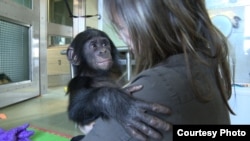
The endangered bonobo is the only primate, other than humans, which engages in sex for reasons other than procreation.(Courtesy "The Bonobo Connection")
'The Bonobo Connection' examines most endangered of African apes
Deep in the forest of the African Congo lives an animal most people have never heard of.
It looks like a chimpanzee, but is smaller and leaner. And like the chimpanzee, it shares almost 99 percent of our DNA.
But these rare creatures of the rainforest are actually bonobos, a completely different species of primate. And while they are the last ape to have been discovered, bonobos may be the first to become extinct.
'Hippie chimps'
While bonobos and chimps are our closest relatives, they are actually very different from each other, especially when it comes to their behavior.
Unlike chimpanzees, which can be aggressive and efficient predators - killing monkeys, and sometimes each other - bonobos are peaceful.
“Whereas chimpanzees have a male-dominated society," says Sally Coxe, president of the Bonobo Conservation Initiative in Washington, "bonobos are matriarchal. The females are in charge.”
Bonobos are also different in that they have a more egalitarian and cooperative society than chimpanzees, she says.
Bonobos are also highly sexual. According to Coxe, “they are the only primate other than humans that has sex not just for procreation. They have sex a lot and they do it in every way, shape or form. They’re actually bi-sexual.”
In fact, bonobos use sex as a way of resolving conflict.
This has given them the label, the ‘make love, not war’ apes or the ‘hippie chimps.’
'The Bonobo Connection'
Award-winning filmmaker Irene Magafan recently completed a documentary called “The Bonobo Connection,” which follows a family of bonobos at the Columbus Zoo in the U.S. state of Ohio.
She says bonobos have gone unnoticed for so long and are extremely underrepresented “because most people just know of chimpanzees. You don’t learn about bonobos in schools or in books. It’s just not there.”
Filmmaker Irene Magafan with baby Teco, the newest addition to the Great Ape Trust in Des Moines, Iowa, in November 2011.(Courtesy Irene Magafan)
And yet bonobos are the most endangered African ape.
Magafan says the biggest threat to bonobos is by far the bush meat trade.
“People are hunting bonobos…they're killing these animals, and they're taking them back to market to sell them.”
Leading scientists estimate there may be as few as 7,000 bonobos left in the wild, all in the Democratic Republic of Congo. And there are less than 200 bonobos in captivity, in the United States and Europe, which may be one of the reasons they have gone ‘unnoticed’ for so long.
But, working with the government and local community, The Bonobo Conservation Initiative has set up two protected nature reserves, including one larger than Belgium.
And then there is Lola Ya Bonobo - the only bonobo sanctuary in the world - located just outside of Kinshasa. Orphaned bonobos are nursed back to health there and if possible, released back into the wild.
Importance of habitat
In making sure there is a protected habitat to return them to, Magafan says, we benefit as well.
“Bonobos inhabit the second largest rainforest in the world," she says. "We have the Amazon rainforest and we then have the Congo forest.These are our lungs of the earth and this is how our earth breathes. The Congo rainforest is where we get a lot of our medicines, and it’s where the earth gets a lot of its oxygen, so imagine us losing that.”
Sally Coxe can’t imagine it either, and says meeting a bonobo is not like anything else on this earth.
“Bonobos are so highly intelligent; they are so naturally compassionate, naturally peaceful, insightful beings that getting to know them personally as I have, they’re like people and in some ways better than people," she says. "We really have so much more to learn about bonobos that we have barely scratched the surface.”
Coxe and Magafan say that by understanding bonobos and how they live, both in the wild and in captivity, we can learn how to live more peaceful lives ourselves.