



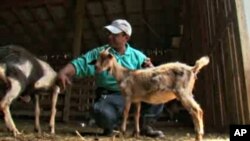
A former telecommunications executive has created a new life for himself in rural America outside of Washington, D.C.. Mukit Hossain moved to a six-hectare farm in Spotsylvania, Virginia to raise goats.
What prompted Hossain to become a goat farmer? Two young daughters and what he saw as an over emphasis on material life.
"It was mostly about designer clothes. It was about conspicuous consumption. It was about boyfriends and girlfriends," he says. "And for five and six year olds to think in those terms, I thought it is quite dangerous, so we decided that we are going to move further south to a farm."
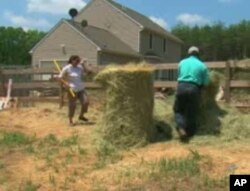
So Hossain reordered his life and started a new career with a mission - to provide the 300,000 American Muslims in Northern Virginia with organic halal meat that's free of hormones and chemicals.
"I feed them mostly grass and hay, and I actually try to purchase hay from local farmers, especially the ones who use natural fertilizers, organic fertilizers," says Hossain.
He does most of the farm work himself, raising and feeding the animals. He says halal means not only slaughtering animals according to Islamic teachings, but also treating them kindly.
"The same kind of care and attention that one gives to pets, I think should be given to the animals you are raising."
Hossain had no previous experience with rural life before becoming a farmer himself. But he's optimistic about his new business.

Besides the growing market among Muslim Americans for halal meat, he says there also is a broader demand for organic healthy food among other Americans.
"I think I have more demand right now than I can keep up with," says Hossain. "My big problem is not finding the customers. My big problem is building up my capacity."
Hossain is winning customers from big health food chains while also building a good reputation with halal stores like the Jummah Bazaar in Springfield, Virginia.
"All Muslims insist on the halal meat," says store owner Muhammad Zahed. "We offer them goat, lamb, beef, veal, all kinds of halal meat that is available here in America."

Hossain's wife Sabrina also works on the farm. She says the move was the healthiest decision they have ever made, especially for their children.
"They do not talk about what nice brand shoes you got at school, but they talk about what 4-H activities they are going to do," says Sabrina Hossain.
"It is a very different approach to life, very quiet and I think it is very peaceful."