


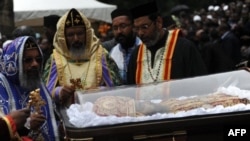
ADDIS ABABA — Thousands of Ethiopians gathered Thursday for the funeral of Abuna Paulos, head of the Ethiopian Orthodox Church. Abuna died last Thursday at the age of 76, four days before the death of Prime Minister Meles Zenawi.
Abuna Paulos’ funeral was held at the Holy Trinity Catholic Church in Ethiopia’s capital Addis Ababa. Among the mourners was Deputy Prime Minister Hailemariam Desalegn, who is set to take over as Ethiopia's new leader.
Most people had to listen to the service on the radio outside the church compound, as the crowd was too large to accommodate everybody. Many people were crying outside, mourning the death of their religious leader.
Bezawit is a clinical nurse in Addis Ababa and and says she respected the religious leader for his work in the community.
“He is a father of the poor and educates them. He wants us to know what we really believe in. And he also helped to control the spread of HIV amongst the youth. We’re very sorry that he died as he was a good father,” she said.
Woldesemait, an Ethiopian businessman, praised how Abuna Paulos’ treated people.
"Father Paulos is a very good person. We came to the funeral because we heard he passed away. He looks at all people equally. He built schools and was a person that helps everybody,” he said.
Many people at the funeral said they will remember Abuna Paulos mostly for his development work in Ethiopia.
But the patriarch was also frequently criticized. His critics felt that his ties with the government were too strong. They also said he tried to make his own position more powerful by attempting to put the patriarch position above the synod, the council of the church.
Also, Abuna Paulos was appointed leader while his predecessor, Abuna Merkorios, was in exile. The Ethiopian Orthodox church officially states that no new patriarch can be appointed if the former one is still alive. Abuna Merkorios and his followers started a rival synod in the United States.
General secretary of the Orthodox Catholic Church, Abuna Heskin, says that people who are criticizing Abuna Paulos are judging without knowing the truth.
“They don’t know him in depth or closely, but he was a good father. We hear some things without having the chance to talk to them personally,“ Heskin said.
Ethiopian Orthodox followers are the dominant religious group in Ethiopia. Abuna Paulos had led the Orthodox Church since 1992. The synod will hold meetings soon to appointment a new patriarch.
Abuna Paulos’ funeral was held at the Holy Trinity Catholic Church in Ethiopia’s capital Addis Ababa. Among the mourners was Deputy Prime Minister Hailemariam Desalegn, who is set to take over as Ethiopia's new leader.
Most people had to listen to the service on the radio outside the church compound, as the crowd was too large to accommodate everybody. Many people were crying outside, mourning the death of their religious leader.
Bezawit is a clinical nurse in Addis Ababa and and says she respected the religious leader for his work in the community.
“He is a father of the poor and educates them. He wants us to know what we really believe in. And he also helped to control the spread of HIV amongst the youth. We’re very sorry that he died as he was a good father,” she said.
Woldesemait, an Ethiopian businessman, praised how Abuna Paulos’ treated people.
"Father Paulos is a very good person. We came to the funeral because we heard he passed away. He looks at all people equally. He built schools and was a person that helps everybody,” he said.
Many people at the funeral said they will remember Abuna Paulos mostly for his development work in Ethiopia.
But the patriarch was also frequently criticized. His critics felt that his ties with the government were too strong. They also said he tried to make his own position more powerful by attempting to put the patriarch position above the synod, the council of the church.
Also, Abuna Paulos was appointed leader while his predecessor, Abuna Merkorios, was in exile. The Ethiopian Orthodox church officially states that no new patriarch can be appointed if the former one is still alive. Abuna Merkorios and his followers started a rival synod in the United States.
General secretary of the Orthodox Catholic Church, Abuna Heskin, says that people who are criticizing Abuna Paulos are judging without knowing the truth.
“They don’t know him in depth or closely, but he was a good father. We hear some things without having the chance to talk to them personally,“ Heskin said.
Ethiopian Orthodox followers are the dominant religious group in Ethiopia. Abuna Paulos had led the Orthodox Church since 1992. The synod will hold meetings soon to appointment a new patriarch.