



News / Science & Technology

Lockheed's Fusion Reactor Plan Draws Skepticism

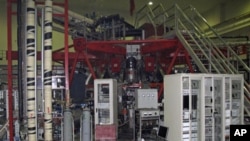
FILE - An experimental nuclear fusion reactor at a laboratory in the Southwest Institute of Physics in Chengdu, Sichuan Province.
George Putic

The recent announcement from technological giant Lockheed Martin that it is perfecting a fusion reactor that it says will be functioning in three years has been met with skepticism.

Other researchers say that nuclear fusion as a sustainable source of power will not be achievable for decades.

Nuclear power was once thought to be the future of cheap electricity production. Today's reactors create power through fission, splitting the nuclei of heavy radioactive elements.

But after several accidents, most notably the 1986 explosion and meltdown of one of the reactors in Chernobyl, the public perception of nuclear power began to change.

Generating nuclear power is safe only while under strict control, with adequate shielding and temperature management.

Otherwise, the reactor’s core becomes too hot and explodes, contaminating the surrounding air, water and soil with long lasting radioactivity.

However, scientists have not abandoned the dream of harnessing the huge amount of energy released by atoms when they change their properties.

And fusion, the opposite nuclear process of fission, still holds the promise of an equally cheap but exponentially safer source of energy. It is the process that powers stars, fusing two atomic nuclei to release energy.

David Ingram, Chair of the Department of Physics and Astronomy at Ohio University, said the difficulty of harnessing nuclear fusion is that it requires a temperature as high as the surface of the sun in order to occur.

“The only way to do that is with either in fairly sophisticated magnetic fields or using a laser-driven system like the National Ignition Facility,” he said.

Ingram said that Lockheed appears to be taking a different approach — using a ‘magnetic mirror’ to confine the hot, electrically charged particles inside the reactor.

The fuel that powers fusion — a harmless mix of two hydrogen isotopes, deuterium and tritium — is abundant, and Ingram says that will make fusion reactors much less expensive to operate than the reactors now in use.

And he said they contain a million times more energy than the equal amount of coal.

Fusion reactors are also safer, said Michael Allen, an expert on nuclear power security at Middle Tennessee State University.

“There’s no residual decay heat or radioactive fission products, said Allen, an Engineering Technology professor. “If the power goes off it just shuts down. Also, it’s inherently safer because you cannot use it for nuclear weapons, as there’s no buildup of uranium or plutonium.”

Almost all of the world’s 400 fission reactors are close to the end of their lifetimes.

While they operate, these coal-fired facilities spew carbon dioxide into the atmosphere, creating pollution and accelerating climate change. So, Allen says, replacing them with new fusion technology can't happen soon enough.

Both the U.S. and European Union have been experimenting with fusion reactors; researchers say they do not expect them to be operational for decades.

However, Lockheed Martin says it may have a functioning prototype by 2017 and a marketable version by 2022.

The new reactor is being developed by the company's secretive Advanced Development Programs division called Skunk Works.

Researchers there were responsible for building such advanced aircraft as the SR-71 Blackbird and F-22 Raptor, which, Ingram said, gives them a degree of credibility.

“To be fair to them, the Skunk Works at Lockheed has been very successful in the past at projects like this,” Ingram said.

Expert Allen also thinks that Lockheed would have not gone public and applied for a patent for its fusion reaction unless they had some evidence that it would work.

And if it does, he said, it’s going to be huge.

“It’s going to be one of the biggest things that have ever happened to the mankind. It will be right up there with the invention of electricity, the invention of internal combustion engine, with the invention of PC, personal computers that we all have at home, the invention of the Internet," he said.

You May Like

What You Need to Know About Benghazi Hearing

House committee on Benghazi was created in May 2014 to investigate causes of and responses to attacks on two US sites More

Will Cricket Score Points with Americans?

All-star cricket teams will hold matches in US cities in an attempt to spark American interest in the sport, which enjoys enormous popularity outside the US More

What Americans Fear More Than Terrorism

Americans are more afraid of this than they are of potential terrorist attacks, according to a new fear survey More

This forum has been closed.
Comment Sorting
Comments page of 2
    Next 
by: mr nobody from: USA
October 26, 2014 11:36 PM
Fusion may not have the answers if the questions are safety or cheap power.

First of all, fission fuel is already cheap. Less than 30% of operating cost are fuel. That does not include construction and licensing. So reducing a nuclear reactors fuel costs will not significantly affect its energy price.

Second a nuclear reactor has never "blown up" from a nuclear reaction. All of the nuclear reactor related explosions have been chemical. Either hydrogen gas mixing with oxygen, or overpressure steam. These chemical reactions are usually the result of a slow out of control reactor coolant failure. A fusion reactor is a different beast, criticality failures could burn all of the available fuel in microseconds. The saving grace for fusion is that there is far less nuclear fuel available in the reactor for a criticality event.

So even a "working" fusion reactor will have difficulty being successful economically.

In Response

by: Chris from: Orange Park
October 29, 2014 4:32 PM
Mr. Nobody,

At least you have your name right... Fission fuel is a huge problem since you cannot properly dispose of the waste along with it be a hidden spot of creating a nuclear bomb. Please they might not blow up but those plants do rupture leaving those areas a place evacuation in my opinion FOREVER. As for the fusion reactor, if it works will have TONS of energy with very little impact to the environment. In theory, with all the water on the planet there is infinite amount of hydrogen fuel to use once we perfect the process. This invention will end the fossil fuel and energy needs of the planet.
In Response

by: Other nobody from: USA
October 27, 2014 9:30 AM
A major advantage of nuclear fusion over fission is that in the case of a "meltdown" there will not be massive amounts of radioactive particles thrown into the surrounding environment. If this was the case with fission we would already operate the world on fission reactors.

by: Donald Fraser Miles from: Elliot Lake, Canada
October 26, 2014 9:01 AM
My own theory is that a repulsion operating magneto could provide high quantities of electricity. A magnetically repulsive operating magneto requires little torque force to turn. It should generate high values of electricity. I don't frankly know how current magnetos function. I believe they operate on magnetic attraction which has high resistance to turning the magneto in operation.

by: Mark from: Virginia
October 25, 2014 9:26 PM
I remember when nuclear reactors for generating electricity was hotly debated and numerous protests abounded when such a facility's construction was proposed (see Three Mile Island- I grew up 300 miles away from that facility, at that time, the closest such nuclear facility. Now I live less than 10 miles away from a nuclear facility). Every concern and fear was raised and debated at that time. Now its just a matter of commonality that these structures exist.

In ten years (if Lockheed is correct in their assessment and time table) newer nuclear facilities will begin to be constructed. I wonder what howls of protest will exist when that happens? If any, that is.

by: captainhurt
October 25, 2014 9:14 PM
Someone has to call them to be transparent and collaborative on this claim. They HAVE TO make it public and transparent. This isn't some widget to sell...this claim has massive planning implications which are thwarted by the company's secrecy and deception.

by: Tom Murphy from: Heartland America
October 25, 2014 8:29 PM
Maybe this is why Saudi Arabia, Iraq and Iran suddenly started slashing the price of a barrel of oil. They would like to undercut, if possible, the cost of a fusion reactor and hope that the fusion project is abandoned on a cost per megawatt basis. But this can re-align global economies and make us all more prosperous - except for OPEC nations. Lower power costs mean lower cost to manufacture products and lower costs to the consumer.

by: Chris Anderson from: Idaho
October 25, 2014 7:56 PM
"...the difficulty of harnessing nuclear fusion is that it requires a temperature as high as the surface of the sun in order to occur."

Umm, the temperature of the surface of the sun, while hot, is paltry compared to the temperatures required to achieve fusion. I have to believe this is a misquote, and that the interviewee actually said "center of the sun." Sloppy reporting.
In Response

by: Mr. Engineer from: South Carolina
October 26, 2014 8:40 AM
I agree - between this, and "inventing" electricity (you "discover" something that exists, you "invent" something new), and the fact that there is no skepticism described in the article (other than "it is advanced technology, so you should not believe it"), I would give this highschool report a C-.

by: Bill Bradley from: Pennsylvania
October 25, 2014 4:24 PM
Maybe this is a typo?

While they operate, these coal-fired facilities spew carbon dioxide into the atmosphere, creating pollution and accelerating climate change. So, Allen says, replacing them with new fusion technology can't happen soon enough.

by: Scott Coristine from: Canada
October 25, 2014 2:58 PM
I know I'm being a bit picky here but "invention of electricity" ? (last paragraph). We didn't invent electricity, its a property of nature..... for a science article this statement blows me away.....

by: shuman from: WI
October 25, 2014 10:26 AM
"Almost all of the world’s 400 fission reactors are close to the end of their lifetimes.

While they operate, these coal-fired facilities spew carbon dioxide into the atmosphere, creating pollution and accelerating climate change. So, Allen says, replacing them with new fusion technology can't happen soon enough."

Who writes this stuff? Fission reactors are not coal-fired. And where is the so-called "skepticism" about the Lockheed technology?

by: Anonymous
October 24, 2014 7:38 PM
Comparing Lockheed's reactor to Chernobyl makes no sense because Lockheed is Fusion, not Fission.
Comments page of 2
    Next 

Featured Videos

Your JavaScript is turned off or you have an old version of Adobe's Flash Player. Get the latest Flash player.
Drug Kingpin El Chapo Guzman Injured During Searchi
X
Alberto Pimienta
October 19, 2015 8:34 PM
Mexican authorities are closing in on the most dangerous drug trafficker in the world, Joaquin “El Chapo” Guzman. “El Chapo” avoided being captured over the weekend but the Mexican government says he’s now injured. VOA's Alberto Pimienta reports.
Video

Video Drug Kingpin El Chapo Guzman Injured During Search

Mexican authorities are closing in on the most dangerous drug trafficker in the world, Joaquin “El Chapo” Guzman. “El Chapo” avoided being captured over the weekend but the Mexican government says he’s now injured. VOA's Alberto Pimienta reports.
Video

Video Kenyan Town Vies to Become East African Cycling Hub

The sport of cycling has steadily built a following in East Africa in recent years. It doesn’t hurt that two-time Tour de France winner Chris Froome was born in Kenya and trained by one of Africa’s best cyclists, David Kinjah. And now the town of Machakos, about 56 kilometers southeast of Nairobi, is trying to become Kenya’s, and perhaps East Africa’s, cycling hub. VOA’s Jill Craig has more from Machakos, Kenya.
Video

Video Taliban Remain Serious Threat in Provinces Around Kunduz

Even though Afghan security forces have regained control of the northern city of Kunduz from the Taliban after fierce fighting, the security situation in the region is still tenuous. VOA’s Ayesha Tanzeem traveled to Baghlan Province, neighboring Kunduz, and has this report on the situation there.
Video

Video Taiwan Finding Niche Markets in China’s Shadow

China’s economy is like a business magnet and as its influence grows its neighbors are finding it increasingly difficult to remain competitive. Like many economies in the region, Taiwan has been hit hard in recent years as China’s so-called “red-supply chain” has drained off talent and opportunities.
Video

Video Amid Congressional Leadership Crisis, Momentous US Fiscal Deadlines Loom

The U.S. Congress faces critical fiscal deadlines at a time of upheaval and uncertainty on Capitol Hill. Lawmakers are returning from a weeklong recess still wondering who will lead the House of Representatives. Michael Bowman reports.
Video

Video Egyptians Vote in Long-delayed Parliamentary Election

Voting in a long-awaited election for a new parliament opened Sunday in half of Egypt's provinces as the government works to complete a roadmap to democracy implemented following the ouster of the country's first freely elected civilian President Mohamed Morsi of the Muslim Brotherhood.
Video

Video Reparations Underway for War Victims in Ivory Coast, Many Still Awaiting

Five years after the deadly 2010 post-election violence in Ivory Coast, the country is determined to consolidate its peace. And to help in that reconciliation, President Alassane Ouattara created agencies aimed at providing reparation for war victims. The first batch of victims was compensated last August. But many are still waiting, and some are losing patience over the lagging process. Emilie Iob reports.
Video

Video Inter-Korean Family Reunions Preparations Under Way

A South Korean advance team that includes Red Cross officials is now in North Korea to prepare for next week’s reunion for families that have been separated by the Korean War. VOA’s Brian Padden reports from Seoul that this rare reunion, that just weeks ago looked unlikely to happen, will offer the 200 selected participants the first opportunity to see their families in over half a century. And it could clear the way to further inter-Korean cooperation.
Video

Video Vets: Syria Not Another Afghanistan for Russia

Russia's military strikes in Syria against enemies of President Bashar al-Assad have raised fears of a proxy war against U.S.-armed rebels. The concerns echo the Soviet Union's 1979 intervention in Afghanistan. Russian veterans of the Afghan War, however, say a similar conflict in Syria is unlikely as long as ground troops are not involved. VOA's Daniel Schearf reports from Moscow.
Video

Video Largest US Prisoner Release to Begin Oct. 30

The United States is beginning its largest prisoner release in history, now that federal sentencing guidelines have been reduced for certain drug offenders. VOA's Carolyn Presutti talks to an inmate who is counting down the days to freedom — and the people who don't think he's yet to earn it.
Video

Video Syrian Refugees in US Struggle to Start Anew

Communities across the United States are welcoming Syrian refugees who have fled their war-torn country and often spent many months, if not years, in refugee camps. But, as VOA’s Greg Flakus reports from Houston, some of their biggest challenges come as they try to adapt to life in a new country.
Video

Video Turkey: Europe’s Offer of Migrant Deal ‘Insincere’

European Union leaders have agreed on a plan to offer Turkey $3.5 billion, together with visa-free travel and renewed accession talks, in return for stopping the flow of refugees and migrants into the EU. But as Henry Ridgwell reports from London, the offer is getting a lukewarm reception in Ankara.
Video

Video Amnesty Accuses Saudi Coalition of ‘War Crimes’ in Yemen

The human rights group Amnesty International has accused the Saudi-led coalition of war crimes in airstrikes against Houthi rebels in Yemen. Henry Ridgwell reports the group says hundreds of civilians have been killed in strikes on residential areas.

VOA Blogs