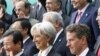



Finance ministers from the G20 nations ended two days of meetings in South Korea with a pledge to ease trade tensions that threaten global recovery. Though short on details, the informal agreement on exchange rates is seen as a step forward in defusing tensions that could lead to protectionism and possible trade wars. But without a viable enforcement mechanism, according to noted American economist Joseph Stiglitz, the pledges are nothing more than symbolic.
Under pressure to show leadership and boost cooperation on rebalancing the world economy, finance leaders meeting in South Korea vowed not to use their currencies as economic weapons to boost exports.
But without agreement on how to measure progress, South Korea's finance minister said cooperation is crucial. "In terms of exchange rates, we decided to move towards more market-determined exchange rate systems that reflect underlying economic fundamentals and refrain from competitive devaluation of currencies," said Yoon Jeung-Hyun said.
The agreement comes amid fears that some nations are devaluing their currencies to gain a competitive edge. The U.S., for example, accuses Beijing of keeping its currency artificially weak to make Chinese goods cheaper.
But some say its not entirely China's fault.
Nobel prize winning economist Joseph Stiglitz says U.S. policies that have driven interest rates to near record lows are also contributing to volatility. "What countries all over the world are saying today is that America's policy of flooding the world with money, quantitative easing, is causing havoc everywhere. The money rather than going into increased lending, which it's not, is looking around the world for the highest return," he said.
Which, he says, puts pressure on international exchange rates.
Stiglitz admits China's yuan, which is pegged to the value of the dollar, needs to rise faster.
But he agrees with Beijing that such steps must be gradual or many Chinese factories, dependent on exports, will close.
"The last thing the world needs now is a crisis in China. So China is right that the first order of the day is to maintain stability. Some adjustment would be I think good for China in that stability, but it has to be done in a controlled manner," he said.
Although the U.S.-brokered plan for market-driven exchange rates has the backing of G20 leaders, numerical targets and enforcement have yet to be agreed upon. World leaders are expected to tackle that issue at the G20 summit next month.
Stiglitz predicts lively debate, but little in the way of agreement. "As I look at the G20, I see such differences in perspectives that I don't think there's going to be a meeting of the minds. And unfortunately it takes a strong mediator to bring everybody together and I don't see that kind of mediation, anybody playing that role in the global economy today," he said.
The role of mediator could go to the International Monetary Fund.
The plan envisioned by G20 finance ministers gives the IMF a greater role in overseeing exchange rates and trade imbalances. But other than applying pressure, the IMF has little or no power over countries that don't borrow from it.