


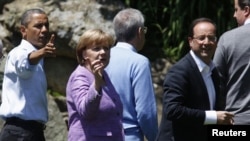
WHITE HOUSE - U.S. President Barack Obama says the leaders of the world’s biggest economies are beginning to agree that more jobs and more growth will help reverse Europe’s economic crisis. The president spoke Saturday at the end of the Group of Eight economic summit.
After two days of talks at the Camp David presidential retreat outside Washington, Obama said the eight leaders acknowledge that budget cuts alone will not restore Europe’s economy.
“And there is now an emerging consensus that more must be done to promote growth and job creation right now, in the context of these fiscal and structural reforms,” the president said.
A statement from the G8 leaders called for a balance between growth and austerity to fight the economic woes.
Obama said the leaders discussed the need for the troubled European countries to continue shrinking their deficits while stimulating economic growth.
“Today we agreed that we must take steps to boost confidence and to promote growth and demand while getting our fiscal houses in order," he said. "We agreed upon the importance of a strong and cohesive Eurozone, and affirmed our interest in Greece staying in the Eurozone while respecting its commitments.”
Political impact
The decisions the leaders make could have political consequences.
The main advocate of European austerity, German Chancellor Angela Merkel, recently saw her party defeated in a local election.
Former French President Nicolas Sarkozy, who also favored budget cuts, was voted out of office, in favor of Francois Hollande, who offered a pro-growth policy.
Many U.S. political analysts say a stagnant economy, blamed partly on Europe’s economic woes, is the biggest obstacle to Obama’s re-election in November.
“The leaders here understand the stakes," Obama noted. "They know the magnitude of the choices they have to make, and the enormous political, economic and social costs if they do not.”
Iran
The G8 leaders also addressed the possibility of oil shortages when new sanctions against Iran’s oil exports take effect late next month.
“And in the face of increasing disruptions in the supply of oil, we agreed that we must closely monitor global energy markets," Obama said. "Together, we stand ready to call upon the International Energy Agency to take action to ensure that the market remains fully and timely supplied.”
Africa
The president hosted a meeting of the G8 leaders and the leaders of Benin, Ethiopia, Ghana and Tanzania to help improve food security in Africa.
Obama said the G8 is committed to building on its 2009 initiative that led to $22 billion in government pledges.
The president said he and his G8 counterparts made progress on numerous other international issues. Among them were Afghanistan, Syria and North Korea.
Most of the leaders have moved on to President Obama’s home city of Chicago for the NATO Summit.
After two days of talks at the Camp David presidential retreat outside Washington, Obama said the eight leaders acknowledge that budget cuts alone will not restore Europe’s economy.
“And there is now an emerging consensus that more must be done to promote growth and job creation right now, in the context of these fiscal and structural reforms,” the president said.
A statement from the G8 leaders called for a balance between growth and austerity to fight the economic woes.
Obama said the leaders discussed the need for the troubled European countries to continue shrinking their deficits while stimulating economic growth.
“Today we agreed that we must take steps to boost confidence and to promote growth and demand while getting our fiscal houses in order," he said. "We agreed upon the importance of a strong and cohesive Eurozone, and affirmed our interest in Greece staying in the Eurozone while respecting its commitments.”
Political impact
The decisions the leaders make could have political consequences.
The main advocate of European austerity, German Chancellor Angela Merkel, recently saw her party defeated in a local election.
Former French President Nicolas Sarkozy, who also favored budget cuts, was voted out of office, in favor of Francois Hollande, who offered a pro-growth policy.
Many U.S. political analysts say a stagnant economy, blamed partly on Europe’s economic woes, is the biggest obstacle to Obama’s re-election in November.
“The leaders here understand the stakes," Obama noted. "They know the magnitude of the choices they have to make, and the enormous political, economic and social costs if they do not.”
Iran
The G8 leaders also addressed the possibility of oil shortages when new sanctions against Iran’s oil exports take effect late next month.
“And in the face of increasing disruptions in the supply of oil, we agreed that we must closely monitor global energy markets," Obama said. "Together, we stand ready to call upon the International Energy Agency to take action to ensure that the market remains fully and timely supplied.”
Africa
The president hosted a meeting of the G8 leaders and the leaders of Benin, Ethiopia, Ghana and Tanzania to help improve food security in Africa.
Obama said the G8 is committed to building on its 2009 initiative that led to $22 billion in government pledges.
The president said he and his G8 counterparts made progress on numerous other international issues. Among them were Afghanistan, Syria and North Korea.
Most of the leaders have moved on to President Obama’s home city of Chicago for the NATO Summit.