


It seems like hardly a week goes by without another planet being discovered in some far off stellar system, but a new study, released by the California Institute of Technology, indicates there will likely be many, many more such discoveries.
The Caltech team made this conclusion based on analyzing the planets orbiting the Kepler-32 star, which contains five planets and which the scientists say is representative of the vast majority of stars in our galaxy. Kepler-32 is classified as an M dwarf, and scientists say three out of every four stars in the galaxy are M dwarfs, also known as red dwarfs.
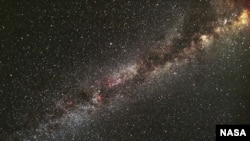
"There's at least 100 billion planets in the galaxy—just our galaxy," says John Johnson, assistant professor of planetary astronomy at Caltech and coauthor of the study, which was recently accepted for publication in the Astrophysical Journal. "That's mind-boggling."
Scientists say their estimate of 100 billion planets is conservative because it doesn’t take into account planets which may be orbiting further away from M dwarfs or planets orbiting other types of stars.
According to the scientists, Kepler-32’s five planets, which were detected by the Kepler space telescope, are similar in size to Earth. They are also similar to other planets discovered around other M dwarf stars. They all orbit very close to their star, no further than one-third the distance Mercury orbits our Sun. This is typical of M dwarf systems, Johnson said.
While the planets may resemble Earth in size, the Kepler-32 system differs from the Solar System. The star is much cooler than the sun, has only five percent of its brightness and is only half the size.
Johnson said an alternate headline for the discovery is just how much of a “weirdo” our own solar system is compared to the vast majority of systems in the galaxy.
Still, the Kepler-32 star system does have what is called a “habitable zone,” where liquid water could exist. In the Kepler-32 system, only the outermost planet is in that zone, but Johnson said it likely resembles Neptune and would likely not support life.
Because of its orientation, Kepler-32 presents itself as a great opportunity to study as all the planets’ orbits are in a plane and can be viewed edge-on as they briefly block the light from the star. These small changes in light allow scientists to determine the planets’ characteristics such as size and orbital speed.
"I usually try not to call things 'Rosetta stones,' but this is as close to a Rosetta stone as anything I've seen," Johnson says. "It's like unlocking a language that we're trying to understand—the language of planet formation."
Johnson said the next big question would be if any of the planets in the habitable zones around M dwarf stars could support life.
“There are 20 different factors on Earth, and we don’t know how to rank them,” Johnson said. “Do we need a moon? It’s important. How critical? Do you have to have plate tectonics?”
Johnson said those questions are best suited for climate scientists and geologists.
“Until we have the ability to study those things, we won’t know if they’re hospitable,” he said. “If you were looking at our Solar System from an alien world, you might write a press release saying you’d discovered two planets in the habitable zone. Venus is in the habitable zone, but it’s not a good vacation spot.”
The Caltech team made this conclusion based on analyzing the planets orbiting the Kepler-32 star, which contains five planets and which the scientists say is representative of the vast majority of stars in our galaxy. Kepler-32 is classified as an M dwarf, and scientists say three out of every four stars in the galaxy are M dwarfs, also known as red dwarfs.
"There's at least 100 billion planets in the galaxy—just our galaxy," says John Johnson, assistant professor of planetary astronomy at Caltech and coauthor of the study, which was recently accepted for publication in the Astrophysical Journal. "That's mind-boggling."
Scientists say their estimate of 100 billion planets is conservative because it doesn’t take into account planets which may be orbiting further away from M dwarfs or planets orbiting other types of stars.
According to the scientists, Kepler-32’s five planets, which were detected by the Kepler space telescope, are similar in size to Earth. They are also similar to other planets discovered around other M dwarf stars. They all orbit very close to their star, no further than one-third the distance Mercury orbits our Sun. This is typical of M dwarf systems, Johnson said.
While the planets may resemble Earth in size, the Kepler-32 system differs from the Solar System. The star is much cooler than the sun, has only five percent of its brightness and is only half the size.
Johnson said an alternate headline for the discovery is just how much of a “weirdo” our own solar system is compared to the vast majority of systems in the galaxy.
Still, the Kepler-32 star system does have what is called a “habitable zone,” where liquid water could exist. In the Kepler-32 system, only the outermost planet is in that zone, but Johnson said it likely resembles Neptune and would likely not support life.
Because of its orientation, Kepler-32 presents itself as a great opportunity to study as all the planets’ orbits are in a plane and can be viewed edge-on as they briefly block the light from the star. These small changes in light allow scientists to determine the planets’ characteristics such as size and orbital speed.
"I usually try not to call things 'Rosetta stones,' but this is as close to a Rosetta stone as anything I've seen," Johnson says. "It's like unlocking a language that we're trying to understand—the language of planet formation."
Johnson said the next big question would be if any of the planets in the habitable zones around M dwarf stars could support life.
“There are 20 different factors on Earth, and we don’t know how to rank them,” Johnson said. “Do we need a moon? It’s important. How critical? Do you have to have plate tectonics?”
Johnson said those questions are best suited for climate scientists and geologists.
“Until we have the ability to study those things, we won’t know if they’re hospitable,” he said. “If you were looking at our Solar System from an alien world, you might write a press release saying you’d discovered two planets in the habitable zone. Venus is in the habitable zone, but it’s not a good vacation spot.”