



News / Africa

Gbagbo Forces Regain Ground in Abidjan, Ivory Coast

Incumbent president is holding out in an underground bunker

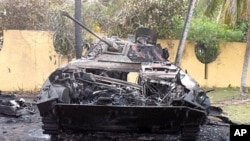
A picture released by the French spokesman for Laurent Gbagbo on April 7, 2011  shows a burnt out tank reportedly in the gardens of the residence of Laurent Gbagbo in Abidjan. (AFP image)
A picture released by the French spokesman for Laurent Gbagbo on April 7, 2011 shows a burnt out tank reportedly in the gardens of the residence of Laurent Gbagbo in Abidjan. (AFP image)
TEXT SIZE - +

Troops loyal to Ivory Coast's incumbent president are regaining ground in the commercial capital, Abidjan.

The incumbent, Laurent Gbagbo, is holding out in an underground bunker, surrounded by forces backing the country's internationally-recognized president, Alassane Quattara.

Forces loyal to Mr. Gbagbo are recapturing parts of downtown Abidjan as well as areas of the Cocody neighborhood where he is in an underground bunker at the presidential compound surrounded by fighters backing Mr. Ouattara.

The head of U.N. peacekeeping, Alain Le Roy, says Gbagbo forces are a kilometer from Mr. Ouattara's hotel headquarters and clearly used a cease-fire meant to negotiate Mr. Gbagbo's surrender last Tuesday to rearm and regroup.

Le Roy said, "The forces of Mr. Gbagbo have since that time regained terrain and they have full control of the Plateau and the Cocody area. They regained forces there. While we speak they might be very close to the Golf Hotel. They have clearly used the lull of Tuesday as a trick to reinforce their position. They tried to say they agreed to negotiate, in fact they were consolidating their position."

Le Roy says Gbagbo troops still have many heavy weapons including tanks, rocket launchers and armored personnel carriers. France says Gbagbo forces shelled its ambassador's residence late Friday, a charge Mr. Gbagbo's spokesman denies.

Having blockaded Mr. Gbagbo in his bunker, Mr. Ouattara is moving to take control of Ivory Coast, calling for an end to European Union sanctions, the reopening of banks and the restarting of Abidjan's oil refinery.

But he is also facing new allegations of human rights abuses by his forces in western provinces near the Liberian border. Human Rights Watch says pro-Ouattara forces killed or raped hundreds of people and burned villages late last month.

HRW is also detailing atrocities by pro-Gbagbo forces, including the killing of 100 men, women and children in a northern town.

The International Criminal Court says there can be no amnesty for abuses committed during this fighting.

You May Like

Experts Weigh In on Challenges of Closing Guantanamo Prison

Former chief military prosecutor at Guantanamo delivers petition to White House with more than 370,000 signatures, demanding facility be closed down immediately More

Karzai to Discuss Enhancing Defense Ties with India

Afghanistan looking for more military aid as it prepares for withdrawal of NATO forces by next year More

India, China Pledge to Overcome Border Tensions

Indian prime minister and Chinese premier attempt to move past tense standoff in the Himalayas during Delhi talks More

Burmese President Opens US Visit with VOA Town Hall Meeting

Ahead of his meeting with President Obama Monday, Thein Sein answered questions on human rights and economic development in his country More

This forum has been closed.
Comments
     
There are no comments in this forum. Be first and add one

Featured Videos

Your JavaScript is turned off or you have an old version of Adobe's Flash Player. Get the latest Flash player.
Video

Video US Oil Surge Could Impact Mideast Geopolitics

The United States will account for a third of new oil supplies over the next five years, and will become energy self-sufficient in 20 years, according to a new report by the Paris-based International Energy Agency (IEA). Although U.S. oil imports from Arab Gulf countries increased last year, analysts predict the U.S. will lose its dependence on Middle East imports, which is expected to have a huge impact on international relations and the balance of power. VOA's Henry Ridgewell reports.