



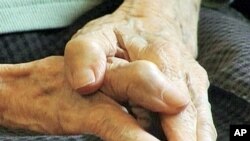
New medical research into a possible cure for Parkinson's disease is focusing on finding biomarkers in patients so that doctors can start treatment early before tremors and other symptoms start. Actor Michael J. Fox's recent commitment of $40 million toward finding a cure for Parkinson's is helping to fund the new research.
The current clinical diagnosis of Parkinson’s is based on visible tremors and stiffness of limbs. But researchers say a more comprehensive diagnosis is needed. Dr. Fernando Pagan at Georgetown University Hospital in Washington is the director of the National Parkinson Foundation Center.
"There are not only motor symptoms, which has been traditionally the mainstay since 1817, but now we are looking at the non-motor features and understanding when they come into play," Dr. Pagan said.
Dr. Pagan and other researchers say environmental and genetic factors could provide clues for diagnosis, treatments and a cure.
They are looking specifically at a biomarker - or a gene - found in many people with Parkinson’s.
"One of the most important genes that we have found out is LRKK2 gene,” he added. “So if we can understand this particular one, we may be able to find a treatment, or a specific cure, for LRKK2."
Dr. Pagan says that up to 40 percent of Parkinson's patients from northern Africa, and some Arab countries, have this gene, and between 11 to 14 percent of patients of Ashkenazi Jewish descent.
Dr. Pagan says the LRKK2 gene may help doctors make an early diagnosis of the disease, but he and other experts stress it is not a cure-all, because Parkinson's has many variations.
Right now, the only thing doctors can do is treat the progressively worsening symptoms.
Dr. Pagan has been involved in a series of trials on methods of intervention.
"All three trials showed that a treatment was better than no treatment and the progression of the disease was slower in those who were early treated virus those who received delayed treatments,” said Dr. Pagan. “We are clearly learning now that treating Parkinson’s from the time we make diagnosis does modify the disease."
Medical researchers say Parkinson's Disease is the second most common degenerative neurological disorder after Alzheimer's with some 10 million people suffering from the disease around the world.