


SUTTON, Nebraska — Walking through Bruce Trautman's cornfields near drought-hit Sutton, Nebraska, you could walk right by Monsanto's genetically-modified, drought-tolerant varieties and not notice a difference.
With about a third less rainfall this season, the leaves are turning brown just like their conventional neighbors.
But Trautman peels back the husks to show ears of modified corn that look bigger, with more kernels than the others.
With a month or so to go before harvest, more hot, dry weather may still take its toll, but, Trautman says, "to see this much difference at this point in time is exceptional."
Risk of drought growing
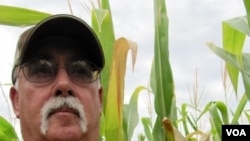
While other researchers and companies are using conventional techniques to improve drought tolerance, Monsanto expects to be the first company on the market with genetically-modified varieties of corn better able to handle the dry weather.
This year's drought across the corn-growing region of the United States has been the worst in decades. But experts say intense droughts are becoming more likely worldwide with climate change.
This year's drought across the corn-growing region of the United States has been the worst in decades. But experts say intense droughts are becoming more likely worldwide with climate change.
Trautman is one of about 250 U.S. farmers field-testing Monsanto's new corn. The main difference, according to Monsanto's Mark Edge, comes down to one gene.
Cellular jam resistance
"The gene is actually found in soil bacteria," Edge says. "It's a common soil bacteria. And what it does for the bacteria is help it survive through that stress."
Added to the corn plant, the gene helps it through drought by keeping its cellular machinery from jamming. The strings of chemical code that carry instructions to the cell's protein-building machines can get tangled up under stress. Adding the bacterial gene helps keep those strings untangled and the machinery running smoothly.
It seems to be helping Bruce Trautman's corn. But that is just one field, and the season is not over yet, so Edge is cautious.
"Growers are very excited about it, but we need to wait until the yields come in to get a better evaluation of that," he says.
A modest step forward
Skeptics, such as Doug Gurian-Sherman with the Union of Concerned Scientists, do not expect big improvements from the genetically-modified corn.
"It's a step forward, but it's very, very modest," he says. And in severe droughts, the added gene may not help much.
"There are more cost-effective and more reliable, at this point, ways of improving things like drought tolerance," Gurian-Sherman says, such as conventional crop breeding and better soil management. "And I think we need to put more of our effort into those areas."
Although he does not have any immediate safety concerns, he says testing should be more rigorous.
'A very powerful tool'
Edge says the crops have been tested and regulators have approved them, and he agrees conventional breeding and soil management are important.
"There isn't one thing that's going to address drought," he says. "It's a combination of things. And this is a very powerful tool."
Farmers will see just how powerful when the harvest comes in this fall.