


"Rainbow" papayas recently went on sale in Japan.
They are the only gene-altered fruit on the market today in Japan, a country with strict laws regarding genetically-modified organisms (GMOs).
Those laws include a requirement that they be labeled as GMOs - a rule that does not exist in the United States.
The papaya’s arrival in Japan comes as advocates in the United States press the government to require labels on all GMO foods.
'Almost like vaccination'
The Rainbow papaya was released in 1998.
U.S. Department of Agriculture scientist Dennis Gonsalves, who helped develop the new fruit variety, may be its best salesman.
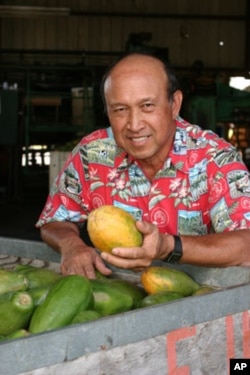
“I’m prejudiced, but I will tell you," Gonsalves says. "This Hawaii-grown papaya is the best in the world. You folks go and taste it.”
But taste was not the reason Gonsalves and colleagues developed it. In the 1990s, a virus ravaged Hawaii’s papaya groves, leaving the industry on the verge of collapse.
So Gonsalves engineered the papaya's genetic makeup to produce a small piece of the virus’s outer shell in its cells, triggering the plant’s immune system.
“It’s almost like vaccination,” he says.
And just like vaccinated people, the genetically-engineered plants do not get sick with the virus. Gonsalves says the piece of virus won't harm people because tests showed it breaks down in three seconds in the harsh environment of the human stomach.
“And, virtually, it saved the papaya industry in Hawaii," Gonsalves says. "So now, Rainbow papaya accounts for 80 percent of Hawaii’s papaya.”
Label debate
But, according to Gonsalves, fighting the virus was only half the battle. They had to convince their biggest customer - Japan - that the fruit was safe to eat.
It took more than a decade of tests before Japanese regulators were satisfied. The last hurdle was labeling.
Japan requires that all GMOs be labeled. That's also the law in the European Union and many other countries, but not in the United States.
A campaign called “Just Label It” seeks to change that.
Not all Americans are convinced GMOs are safe.
“And while the debate is raging on, and while we’re collecting data on the impacts of these very, very new crops, people deserve and need and have the right to know whether to participate in that system or not,” says Gary Hirshberg, CEO of Stonyfield Farm, a major organic yogurt company and a backer of the campaign.
He and others cite polls showing that more than 90 percent of people say products containing GMOs should be labeled.
But those numbers don't mean much, says Val Giddings, with the Information Technology and Innovation Foundation.
“People always opt for more information," says Giddings, "whether or not they have any idea what it means, or how they might use it.”
Giddings has worked on GMO policy for three decades. He points to research in the European Union, where labels are required, which shows that even consumers who say they avoid GMOs still buy products with GMO ingredients on the label.
Giddings says labeling supporters are trying to mislead consumers into thinking that authorities have concerns about the safety of gene-altered foods. He says they don't.
“Every authoritative body who’s looked at this without preconceptions has concluded that crops improved through biotechnology are at least as safe as their conventional counterparts.”
Major U.S., E.U. and international scientific advisory groups have agreed that today’s crop of GMOs do not pose a risk to health or the environment.
But they also say it may be appropriate to monitor these crops after they are on the market. That would not be easy, but labels would help.
Testing the market
The Rainbow papaya went on sale in Japan a few weeks ago with a label that says it is a GMO. Gonsalves hopes his fruit will help answer lingering questions about genetically modified foods.
“Now, instead of lots of speculation, ‘Oh, my gosh, these people aren’t going to eat it because they don’t like this.’ They’re all speculating," he says. "There is no test case. Now there is a test case.”
Gonsalves calls it the "Super Bowl" of marketing challenges: getting a population that's still widely skeptical of genetic-engineering technology to enjoy a beautiful, delicious papaya with a GMO label on it.