



![A news anchor provides the news from the studio of PIK [First Caucasus News], a new state-funded, Russian language TV channel designed to break Moscow’s information grip on the region, Tbilisi, Georgia, August 2011](https://gdb.voanews.com/df1c523c-d960-42ef-ab11-7c64fd9f4749_w250_r1_s.jpg)
Russia and Georgia have had no diplomatic ties since their war several years ago. Georgians currently are reaching out, however, to their much larger neighbor through a new Russian language TV channel.
Three years ago, Russia's hard power rolled south into Georgia. Now, Georgia's soft power is beaming north into Russia.
Georgia’s nationalist government discourages the use of Russian. It makes an exception, though, for PIK, or First Caucasus News, a new state-funded, Russian language channel designed to break Moscow’s information grip on the region.
Katya Kotrikadze studied journalism in Moscow. Now home in Georgia, she broadcasts back to Russia.
"The main idea is to show information about the region, which is an informational background now on the stage," Kotrikadze said.
Disrupting the status quo
As news director, she said that through the Internet and via satellite, PIK can shake up local news monopolies.
"This is the only Russian language TV channel which is on satellite which is not controlled by anyone. We don’t have censorship here. This is very good for us," Kotrikadze said.
After launching six months ago, PIK now broadcasts around-the-clock. Its bilingual English-Russian website draws some 50,000 viewers a day.
Robert Parsons, a Radio Free Europe veteran, is director general.
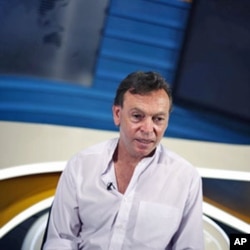
"It is very important for Georgia that it has normal relations with the peoples that surround it. The information that the peoples of the North Caucasus receive from their own media, the Russian media, is entirely negative about this country," said Parsons. "So what the Georgians are trying to do is trying to connect with the peoples of the North Caucasus - saying, 'Judge for yourself on the basis of real, objective, impartial information about what this country's about.'"
Making a connection
Since the Soviet Union fell apart two decades ago, Chechens - Georgia’s Muslim neighbors to the north - repeatedly have allied with enemies of Georgia’s central government.
Foreign Ministry Deputy Minister Tornike Gordadze sees PIK as part of a larger Georgian policy to reach out to neighboring groups in Russia.
"Georgia has to promote its positive image to the North Caucasus to avoid another problem like this, if one day Russia wants to reinvade Georgia, the North Caucasians who are used in the adventure would think twice before following Russia."
Criticism, and olive branch
Although PIK aims to broadcasts unbiased news to Georgia's Russian-speaking neighbors, opposition politician Nino Burjanadze warns that Georgia is pursuing a dangerous policy.
"Georgia is not some superpower who should be trying to intervene in the internal relations of another country - even a superpower should [not] be do [doing] that. But in these circumstances, this is a really provocative step," said Burjanadze.
But so far, Russia has been giving PIK a seat at the table. Russia President Dmitry Medvedev invited Kotrikadze to join two Russian reporters for an hour-long interview marking the third anniversary of the August 2008 Russia-Georgia War.