



Ghana's main opposition challenger says he is not ready to concede defeat in the country's recent presidential election, but says his party has not decided whether it will challenge the results in court.
Nana Akufo-Addo said Monday that his New Patriotic Party is compiling data from polling stations before deciding on how to precede. He said a decision will likely be made in the coming days.
Ghana's election commission says Akufo-Addo came in second with a little less than 48 percent of the vote, while incumbent president John Dramani Mahama won reelection with 50.7 percent of the vote. The president needed to receive more than 50 percent of the ballots cast to avoid a run-off election.
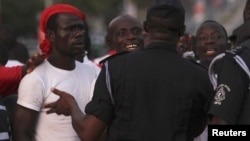
Ghana's capital, Accra, was calm on Monday. Before the election results were announced Sunday, there were protests in Accra with hundreds of Akufo-Addo's supporters alleging that the election had been marred by fraud.
At one point, police fired tear gas to disperse the crowds.
The United States has congratulated President Mahama and people of Ghana, calling the vote a "successful election." A White House statement encouraged all parties to accept the result and to use the legal process to resolve any disputes.
The head of the Economic Community of West African states praised the vote as peaceful and "encouraging" for Ghana.
ECOWAS commission president Kadre Desire Ouedraogo helped lead a team of ECOWAS election monitors. He says that despite some problems with voting machines, he is pleased by the organization of the balloting.
"I have observed that there was strong enthusiasm from all parts around these elections. We have visited many polling stations, and what we observed is very encouraging for democracy in Ghana. I would recommend all the Ghanaian people and political leaders to continue this way so as to keep the peace and stability in this country," he said.
In a brief victory speech, Mahama urged the leaders of rival parties to "respect the voice of the people."
Friday's election marked the first time Ghana used a new biometric registration system that scans fingerprints to identify registered voters. Logistical and technical problems forced the polls to stay open into Saturday.
Despite the glitches, international observers say the vote appeared to be transparent and peaceful. Ghanaian officials estimated voter turnout at close to 80 percent.
The West African country has earned a reputation for stability in an often turbulent region because of its recent record of peaceful, democratic transfers of power.
During the height of the protests, Ghanaian Police Commissioner Rose Bio-Atinga sought to reassure the public.
"We are everywhere, the police are everywhere, the military you can see them, they are everywhere, so we are up to the task. We do not close police stations, we did not stop night patrols, neither did we stop our day patrols, our men are everywhere so let me assure the general public that they are safe," she said.
In addition to electing a president, voters chose 275 members of parliament, where President Mahama's National Democratic Congress has held a majority of seats.
Ghana is also one of Africa's fastest growing economies and is beginning to benefit from commercial oil production that began in 2010.
But many residents, complaining of high living costs and low wages, say they want more immediate benefits from the country's oil wealth, which is expected to grow rapidly in the coming years.