


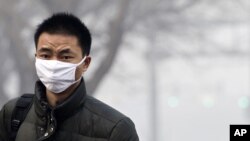
A lot of attention is being paid to greenhouse gas emissions that contribute to climate change. But scientists warn that other pollutants may make it harder to breathe in some places in years to come.
By the year 2050, taking a deep breath in eastern China, northern India, the Middle East and North Africa could be hazardous to your health. That’s what a new study says unless nations take action now to curb air pollution.
Dr. Andrea Pozzer of Germany’s Max Planck Institute of Chemistry says that “strong actions and effective legislation are essential to avoid a drastic deterioration of air quality.” He says there are five main air pollutants.
“Sulfur dioxide, carbon monoxide. Then we have nitrogen dioxide, ozone, and finally we have this so-called PM2.5 – particulate matter, which is below 2.5 micrometers. That’s the size of the particulate matter,” he said.
The U.S. Environmental Protection Agency says particles of 2.5 micrometers are “small enough to invade even the smallest airways,” such as deep inside the lungs. These pollutants are not the same as those that contribute to climate change.
He said, “The ones driving global warming are so-called greenhouse gasses like carbon dioxide and methane, for example, and ozone as well. While in this case these pollutants needed for air quality calculation are rather different. And in this case, these are traces and gasses that are more dangerous for human health.”
Pozzer said the particles that pollute come from both nature and humans, also referred to as anthropogenic emissions.
“This could be natural dust, for example, in the desert where you find a lot of particles. So there’s a very high concentration of PM2.5, or even in very polluted locations like close to a factory. When there are smoke films coming out, these generally contain [a[ high level of particles. Let’s take, for example, sulfur dioxide. These are emitted by volcanoes and at the same time it’s manmade, also emitted by factories. And in this case nowadays anthropogenic emissions are by far the major emitters of sulfur dioxide,” he said.
India and China have rapidly growing economies, and with growth comes greater pollution. Pozzer said it’s happened before.
“Let’s suppose for U.S. or Europe. This would have been the same during the 60s and the 70s and the 80s. Big growth in the economy, and there was the appearance of acid rains and so on. So it’s history that comes back,” he said.
He said China, India and the Middle Eastern and North African countries should take strong action before 2025. He calls that year the “tipping point” when air pollution could start getting extremely bad.
While North African countries could face worsening air pollution, sub-Saharan African countries could be largely spared.
He said, “There will be local pollution due to these megacities or huge cities that they will form of course – an increase of population. So very localized hotspots like huge cities, while in general, in Africa, the air will be more than clean I would say.”
Pozzer added that China, India and the other countries should follow the example of the U.S. and Europe in curbing air pollution. He says while pollution controls are expensive, they pay for themselves through better health of the population.
By the year 2050, taking a deep breath in eastern China, northern India, the Middle East and North Africa could be hazardous to your health. That’s what a new study says unless nations take action now to curb air pollution.
Dr. Andrea Pozzer of Germany’s Max Planck Institute of Chemistry says that “strong actions and effective legislation are essential to avoid a drastic deterioration of air quality.” He says there are five main air pollutants.
“Sulfur dioxide, carbon monoxide. Then we have nitrogen dioxide, ozone, and finally we have this so-called PM2.5 – particulate matter, which is below 2.5 micrometers. That’s the size of the particulate matter,” he said.
The U.S. Environmental Protection Agency says particles of 2.5 micrometers are “small enough to invade even the smallest airways,” such as deep inside the lungs. These pollutants are not the same as those that contribute to climate change.
He said, “The ones driving global warming are so-called greenhouse gasses like carbon dioxide and methane, for example, and ozone as well. While in this case these pollutants needed for air quality calculation are rather different. And in this case, these are traces and gasses that are more dangerous for human health.”
Pozzer said the particles that pollute come from both nature and humans, also referred to as anthropogenic emissions.
“This could be natural dust, for example, in the desert where you find a lot of particles. So there’s a very high concentration of PM2.5, or even in very polluted locations like close to a factory. When there are smoke films coming out, these generally contain [a[ high level of particles. Let’s take, for example, sulfur dioxide. These are emitted by volcanoes and at the same time it’s manmade, also emitted by factories. And in this case nowadays anthropogenic emissions are by far the major emitters of sulfur dioxide,” he said.
India and China have rapidly growing economies, and with growth comes greater pollution. Pozzer said it’s happened before.
“Let’s suppose for U.S. or Europe. This would have been the same during the 60s and the 70s and the 80s. Big growth in the economy, and there was the appearance of acid rains and so on. So it’s history that comes back,” he said.
He said China, India and the Middle Eastern and North African countries should take strong action before 2025. He calls that year the “tipping point” when air pollution could start getting extremely bad.
While North African countries could face worsening air pollution, sub-Saharan African countries could be largely spared.
He said, “There will be local pollution due to these megacities or huge cities that they will form of course – an increase of population. So very localized hotspots like huge cities, while in general, in Africa, the air will be more than clean I would say.”
Pozzer added that China, India and the other countries should follow the example of the U.S. and Europe in curbing air pollution. He says while pollution controls are expensive, they pay for themselves through better health of the population.