


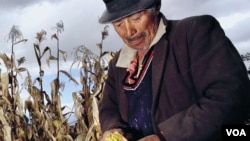
The 2012 Global Hunger Index says hunger remains a serious problem worldwide, with alarming levels in some countries. The Index links hunger to the unsustainable use of land, water and energy resources.
The Global Hunger Index is published annually by the International Food Policy Research Institute, or IFPRI; Concern Worldwide; and the private German development agency Welthungerhilfe.
It says 17 countries have hunger levels described as alarming, while three others are listed as extremely alarming—namely, Burundi, Eritrea and Haiti. Despite the situation in the two African countries, the Index says the sub-Saharan region has made progress against hunger over the last 5 to 10 years. South Asia, on the other hand, has made little progress during that same period, despite having done well in the 1990s.
“It’s a measure of three dimensions of hunger: undernourishment, child underweight and child mortality that are equally weighted,” said Claudia Ringer, deputy division director of IFPRI’s Environment and Production Technology Division and co-author of the Global Hunger Index.
The Index also lists countries that have made good strides against hunger.
“Those countries with the best performance include Angola, Bangladesh, Ethiopia, Malawi, Nicaragua, Niger and Vietnam,” she said.
Ringer added that the Index ties hunger to the unsustainable use of land, water and energy.
“The reason that those two issues are closely interlinked is that the poor depend disproportionately on natural resources. They tend to be farmers, herders, fishermen and women, who directly work with and live on land, water and energy resources. As such, they are particularly disadvantaged as a result of growing scarcity and degradation of these natural resources,” she said.
She said, at the same time, those who are hungry tend to lack rights to the land they farm, and have limited access to water, sanitation and modern forms of energy. The key drivers for resource scarcity, Ringer said, are population changes, higher and skewed incomes, poor policies and weak institutions.
The Global Hunger Index says signals of resource scarcity include the many food price spikes since the 2007/2008 food crisis, large international land deals targeting sub-Saharan African countries, rapidly rising energy prices and a loss of biodiversity.
The Index recommends securing land and water rights for local populations, phasing out inefficient subsidies for water, energy and fertilizers, increased agricultural technology and improved education and reproductive health services for women.
The Global Hunger Index is published annually by the International Food Policy Research Institute, or IFPRI; Concern Worldwide; and the private German development agency Welthungerhilfe.
It says 17 countries have hunger levels described as alarming, while three others are listed as extremely alarming—namely, Burundi, Eritrea and Haiti. Despite the situation in the two African countries, the Index says the sub-Saharan region has made progress against hunger over the last 5 to 10 years. South Asia, on the other hand, has made little progress during that same period, despite having done well in the 1990s.
“It’s a measure of three dimensions of hunger: undernourishment, child underweight and child mortality that are equally weighted,” said Claudia Ringer, deputy division director of IFPRI’s Environment and Production Technology Division and co-author of the Global Hunger Index.
The Index also lists countries that have made good strides against hunger.
“Those countries with the best performance include Angola, Bangladesh, Ethiopia, Malawi, Nicaragua, Niger and Vietnam,” she said.
Ringer added that the Index ties hunger to the unsustainable use of land, water and energy.
“The reason that those two issues are closely interlinked is that the poor depend disproportionately on natural resources. They tend to be farmers, herders, fishermen and women, who directly work with and live on land, water and energy resources. As such, they are particularly disadvantaged as a result of growing scarcity and degradation of these natural resources,” she said.
She said, at the same time, those who are hungry tend to lack rights to the land they farm, and have limited access to water, sanitation and modern forms of energy. The key drivers for resource scarcity, Ringer said, are population changes, higher and skewed incomes, poor policies and weak institutions.
The Global Hunger Index says signals of resource scarcity include the many food price spikes since the 2007/2008 food crisis, large international land deals targeting sub-Saharan African countries, rapidly rising energy prices and a loss of biodiversity.
The Index recommends securing land and water rights for local populations, phasing out inefficient subsidies for water, energy and fertilizers, increased agricultural technology and improved education and reproductive health services for women.