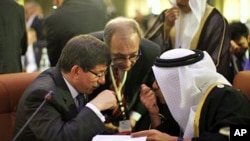
Ankara is turning up the pressure on Damascus over its ongoing crackdown on dissent. The Turkish foreign minister hosted an international meeting on mediation of conflicts on Saturday in Istanbul and has warned the country's patience is running out over the ongoing violence in Syria.
Turkish Foreign Minister Ahmet Davutoglu expressed growing frustration and impatience with the United Nations for its failure to intervene to try and stop the ongoing bloodshed in Syria.
We have seen the U.N. is sometimes too late in making the necessary interventions and sometimes loses time with internal discussions, he said, adding that Arab countries and Turkey had presented a joint resolution on Syria that was vetoed by the Security Council and he said this has created a major discussion on the functioning of the U.N.
Ankara strongly condemned Moscow's and Beijing's veto earlier this month of a U.N. Security Council motion aimed at punishing Damascus over its ongoing crackdown on dissent. On Saturday, Davutoglu warned that if the situation in Syria continues, Ankara may have to consider other options than diplomacy.
Ankara has refused to rule out creating a humanitarian buffer zone to protect refugees in Syria, but says that is not on the agenda now. Turkey has a 900 kilometer border with Syria and has repeatedly raised concerns over a mass influx of refugees into the country.
The Turkish foreign minister last month said its border is open to all wanting sanctuary. Currently there are about 8,000 Syrian refugees in Turkey.
For now Ankara is continuing its diplomatic efforts. Those efforts are strongly supported by the president of the U.N. General Assembly, Nassir Abdulaziz al-Nasser. Speaking at a press conference with the Turkish foreign minister on Saturday, he praised Turkish efforts.
The U.N. General Assembly president said Turkey will be hosting the next "Friends of Syria" meeting in March which will follow up on the meeting in Tunis Friday and he said there is a lot work to be done and he said Turkey is taking responsibility in the way of bringing peace and responsibility in the region.
Ankara is working to build a coherent and strong alliance against the current Syrian government. For now that alliance is seeking diplomatic efforts to resolve the crisis, but observers say such an alliance would be crucial in any direct intervention into Syria that Ankara could possibly take in the future.
Growing Concern in Turkey Over Bloodshed in Syria
- By Dorian Jones