


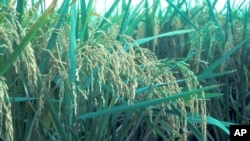
What if there was a method that could help developing-world farmers grow more rice while using less water and fewer chemicals than their usual methods?
It could make a big difference at a time when the population is growing, farming costs are rising, and water is becoming scarcer.
Advocates say they have just such a method, called simply the System for Rice Intensification (SRI).
But some of the biggest names in rice research say if it sounds too good to be true, it probably is. The techniques are spreading in developing world, however, with or without their support.
'Even I didn't believe it'
The environmental group the World Wide Fund for Nature (WWF) has brought Duddeda Sugunavva from her fields in the Indian state of Andhra Pradesh to a recent lunchtime conference in Washington, DC. She gets excited when she describes her experience with SRI.
"Even I didn't believe it initially," she says. "The first time I did it, I didn't believe that it could be possible. Then I tried it, and then I believed it."
It may be hard to believe, but Sugunavva says she produces more grain while putting fewer plants in the field and spacing them farther apart than she normally would. She uses less water because her fields are flooded and drained, not constantly flooded like rice paddies usually are. She fertilizes with manure, and weeds and aerates the soil with a simple tool. That reduces the cost of, and pollution from, inputs like chemical fertilizers and herbicides.
Dramatic gains
Using these tricks and a few others, Sugunavva says she's been amazed by the results.
"This is not the first day I'm doing agriculture. I've been doing it for 20 years," she says. "In the conventional method, the maximum you get is 100, 120 [grains per plant]. With this, I'm getting 300 and change."
Sugunavva says she makes enough money now to pay off some debts and buy a water buffalo to bring in extra income.
And she is not alone. The conference highlighted a report that says in eight countries, farmers using SRI increased yields by nearly half, reduced water use by 40 percent and costs by 23 percent, and increased their incomes by two-thirds on average.
Biksham Gujja heads a joint project of WWF and the global agriculture research institute ICRISAT. He says the idea that farmers can get more with less goes against what experts have been saying for years.
"We told the farmers the last three, four decades, 'If you want a little bit more, by the way, you've got to give more. You've got to give more seeds, more water, more fertilizer,'" he says. "Giving more has become so much more, they got into a debt trap. And also, they've spoiled the entire environment and ecosystem."
Backing lacking
Gujja says SRI could be a simple, inexpensive way to help change that. But he says because there is no money to be made, the system is not getting the support it deserves.
"It is so simple that…no one wants to promote it. No one wants to invest in it," he says. "If it [was]…a genetic modification or some sort of high-tech solution, some sort of hybridization, probably the money would have flowed."
Advocates say SRI deserves more support from leading global institutions like the International Rice Research Institute (IRRI).
'Unproven claims'
But IRRI's research program manager, Achim Dobermann, says supporters paint an overly rosy picture of SRI.
"There are some, I think, fundamental questions we have about some of the unproven claims," he says.
Doberman says there are many studies that do not show SRI improving yields or incomes. When farmers do see improvements, he says it may be because they were not using the best practices to begin with -- practices that IRRI has been recommending for years.
Dobermann says SRI might work on small farms. But it takes a lot of labor. And farming is moving in the opposite direction, he says, toward larger, mechanized operations.
"I look at SRI as not fundamentally wrong," he says, "but it's an evolutionary step backward in farming."
Philosophical differences
And that highlights a philosophical difference between SRI's backers and skeptics. SRI's champions tend to be supporters of small-scale organic agriculture, while detractors question whether organic farming can feed a growing world.
Back at the Washington conference, Oxfam President Raymond Offenheiser says the two camps need to reconcile their differences.
"We've got to stop seeing these questions in terms of being polarized," he says. "And we've got to be looking at [as], in a resource-constrained world, how do we come up with smart approaches without getting into highly contentious polemics over the appropriateness or viability or sustainability of either one?"
Offenheiser says hundreds of thousands of farmers worldwide are adopting SRI methods, and the World Bank and the US Agency for International Development are making some small investments in SRI projects. Meanwhile, research is continuing in order to answer some of the lingering questions about how effective SRI really is.