



The spreading oil spill in the Gulf of Mexico is contaminating nesting and feeding grounds for sea turtles.
All six species in U.S. waters are listed as endangered or threatened under the Endangered Species Act.
Fragile species
Barbara Schroeder, who coordinates the National Sea Turtle Program for the National Oceanic and Atmospheric Administration, says among the 500 recovered in near-shore waters or washed ashore, only about 50 were alive. She says those numbers are much higher than in previous years.
"We know that some of it is just an increased effort and awareness of the turtle situation, but that certainly doesn't explain it all."
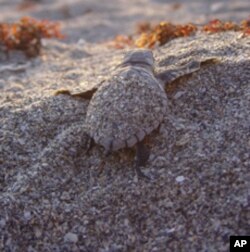
Schroeder says all the 150 turtles captured so far in deeper Gulf waters were covered with oil. And, it's in these deeper waters where turtles spend their lives. Only females return to beaches to lay their eggs.
Peak of nesting season
Wildlife biologist Debbie Crouse is a leading turtle expert with the U.S. Fish and Wildlife Service, the agency charged with protecting the endangered species.
She says the massive Gulf oil spill comes at the peak of the nesting season. "We're seeing a few nests that are hatching and hatching turtles run down the beach and head out to sea."
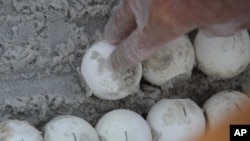
Weighing the risks of oil-soiled water and seaweed feeding grounds, the U.S. Fish and Wildlife Service, along with other government agencies and volunteers, are working together to mark, monitor and - just prior to hatching - hand-excavate some 70,000 eggs from 800 nests buried in Gulf of Mexico beaches and move them to Florida's Atlantic coast.
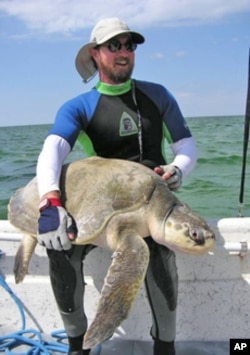
Crouse says that move is the best of a suite of bad alternatives. "We'd prefer not to move any if we could. We are moving those that we feel we absolutely have to because we think that the mortality rate otherwise will be extremely high if not absolute."
Moving day
The turtle eggs - packed in Styrofoam nest boxes - are being trucked some 800 kilometers to climate-controlled warehouses at the Kennedy Space Center in Florida.
Crouse says the turtles are genetically programmed to return to nest on the same beach where they were born. "And by moving them to the Atlantic, we do not know whether they will then start becoming Atlantic turtles, come back to the Gulf [of Mexico] eventually or get lost and not know where to go."
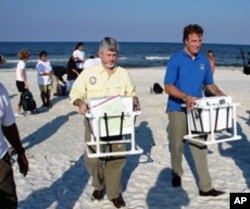
The turtle relocation program has generated extraordinary public and scientific interest, says Karen Kearney, managing director of the Audubon Aquarium of the Americas in New Orleans.
Her organization has been designated by the National Oceanic and Atmospheric Administration as a primary responder for the rescue, rehabilitation, and release of all marine mammals and sea turtles along the Louisiana coast.
She says bringing more observers to the process and can "engage the public and develop new partnerships to save these species."
Hatchlings from one nest were released mid-July. The rest are still incubating and will be released on Atlantic beaches as they hatch.