



Egyptian soldiers have taken positions between pro- and anti-government protesters in Egypt's capital, where gunfire erupted early Thursday after violent clashes between the two sides.
Several tanks were stationed near Cairo's Tahrir (Liberation) Square, as thousands of anti-government protesters gathered there and built barricades.
|
Listen to VOA’s Luis Ramirez’s debriefer on the overnight clashes in Cairo:
|
One of the tanks stood on a highway overpass, where earlier Thursday, supporters of President Hosni Mubarak had been throwing rocks at anti-government protesters below.
News reports cited witnesses as saying at least four people were killed in the latest violence that broke out before dawn.
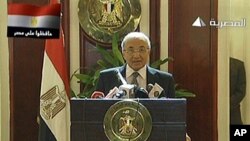
Also Thursday, Prime Minister Ahmed Shafiq apologized for violent clashes that broke out Wednesday when supporters of Mr. Mubarak surged into Tahrir Square and faced off against opposition demonstrators. He called the incident a "disaster" and said it would not happen again.
In his news conference carried on state television, Mr. Shafiq also said he has begun talks with opposition members.
|
VOA’s Mohamed Elshinnawi spoke to Egyptian opposition leader Osama El Ghazali Harb about the state of the anti-Mubarak camp; the interview was recorded February 2, 2011.
|
The anti-Mubarak opposition has called for more demonstrations Friday to press their demand for the president's departure.
After Wednesday's violence, doctors set up a makeshift clinic in a mosque near Tahrir Square to help the more than 640 injured. Egypt's health ministry said the official death toll in the last 24 hours stands at five.
Reporters said Egyptian troops initially fired warning shots in a bid to end the melee. But the military mostly restricted itself to guarding the Egyptian Museum and using water cannons to extinguish flames stoked by the firebombs.
Anti-government protesters accuse Mr. Mubarak's government of unleashing paid vandals and undercover police to crush their unprecedented uprising. The Interior Ministry denied the charge.
Mr. Mubarak, 82, announced late Tuesday he will not seek reelection in September, but he vowed to serve out his term until then. He spoke after an estimated 250,000 people flooded Tahrir Square to demand his resignation. Anti-Mubarak protesters also rallied in other major Egyptian cities.
Egypt's newly appointed Vice President, Omar Suleiman, Wednesday urged all demonstrators to respect the curfew and go home, saying his dialogue with political forces depends on an end to street protests.
Some information for this report was provided by AP, AFP and Reuters.