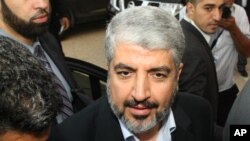
Hamas leader Khaled Meshaal arrives at the Islamist Ennahda party congress in Tunis, July, 12, 2012.
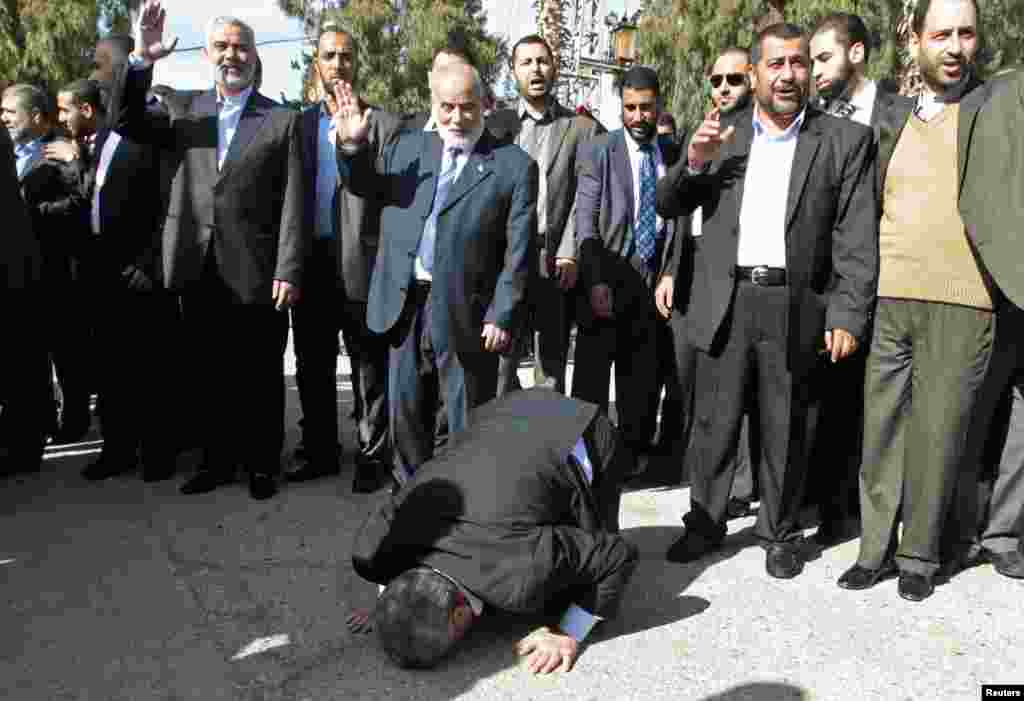
The exiled leader of the Islamist Palestinian militant group Hamas stepped onto Gaza soil for the first time in 45 years and kissed the ground after crossing from Egypt.
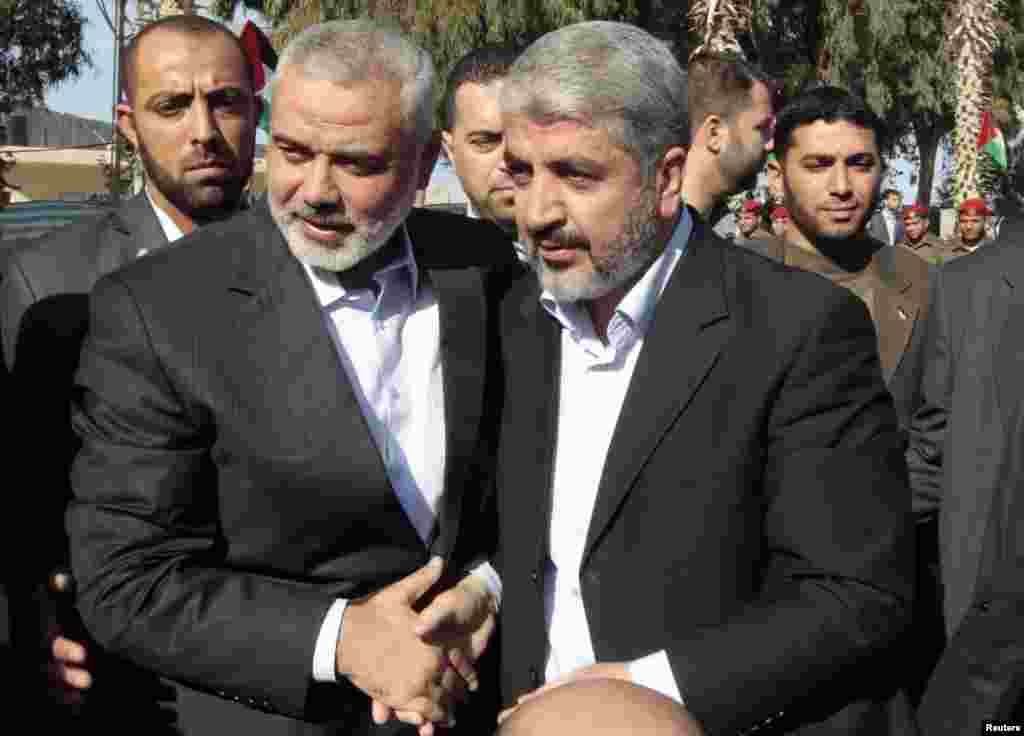
Khaled Meshaal was greeted by crowds of supporters, including Gaza's Prime Minister Ismail Haniyeh and other Hamas leaders and friends when his convoy crossed the border from Egypt into the Palestinian territory.
Surrounded by heavy security, Meshaal told reporters he was overjoyed at finally setting foot in Gaza. He said he hoped to become a martyr for his homeland. "I am back in Gaza," said Meshaal. "And I say I am back because I never visited Gaza before, but Gaza was always in my heart. I am back in Gaza because it never left my heart."
Hamas Leader Ends Exile With Gaza Visit
1/5Hamas chief Khaled Meshaal (front R) walks with senior Hamas leader Ismail Haniyeh (front L) upon his arrival at the Rafah crossing in the southern Gaza Strip, December 7, 2012.
Khaled Meshaal, the leader of the Islamist Palestinian militant group Hamas has arrived in Gaza.
Show moreShow less
2/5Hamas chief Khaled Meshaal prays, with his head to the ground, upon his arrival at the Rafah crossing in the southern Gaza Strip, December 7, 2012.
Khaled Meshaal, the leader of the Islamist Palestinian militant group Hamas has arrived in Gaza.
Show moreShow less
3/5Hamas chief Khaled Meshaal (L), rides in a car with senior Hamas leader Ismail Haniyeh (R), and waves to the crowd upon his arrival in the southern Gaza Strip, December 7, 2012.
Khaled Meshaal, the leader of the Islamist Palestinian militant group Hamas has arrived in Gaza.
Show moreShow less
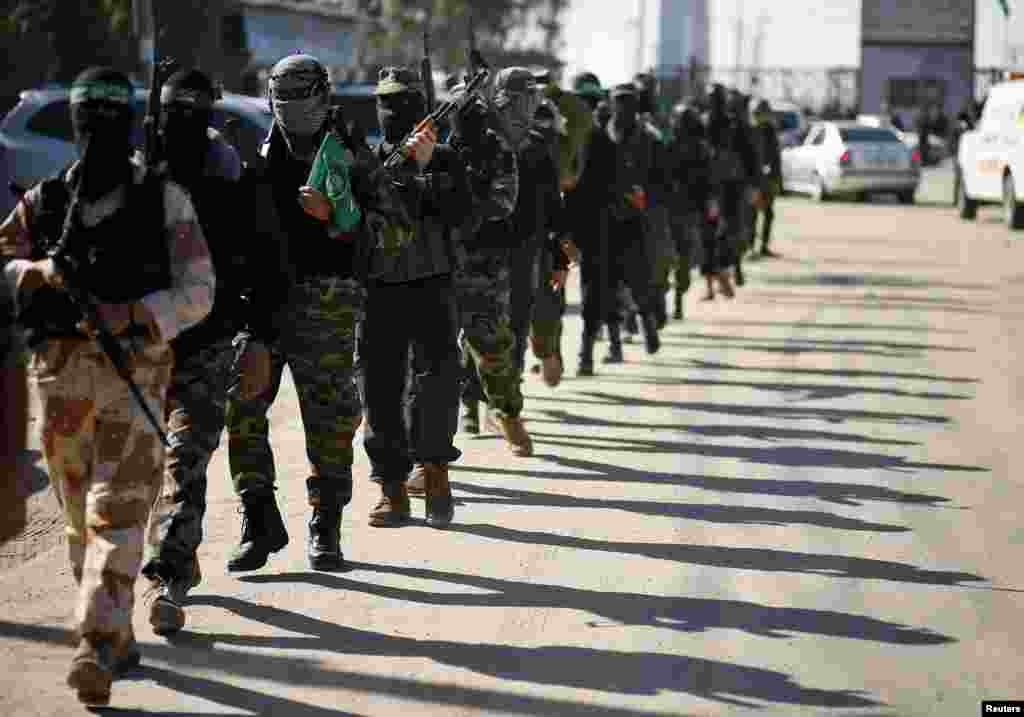
4/5Palestinian members of the al-Qassam brigades, the armed wing of the Hamas movement, stand guard as they wait for the arrival of Hamas chief Khaled Meshaal in Rafah in the southern Gaza Strip, December 7, 2012.
Khaled Meshaal, the leader of the Islamist Palestinian militant group Hamas has arrived in Gaza.
Show moreShow less
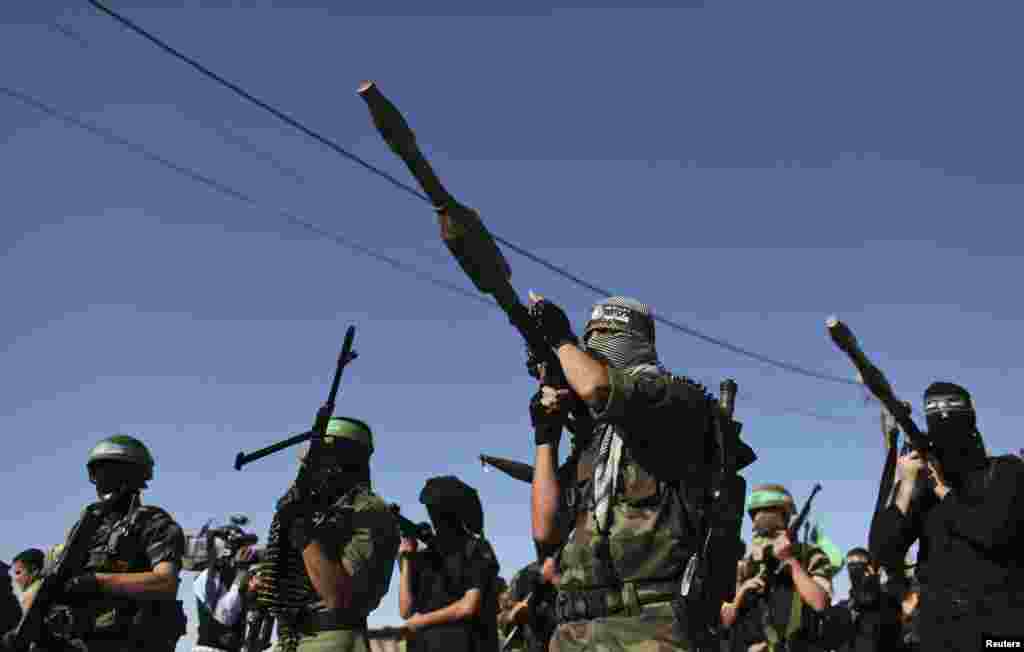
5/5Palestinian members of the al-Qassam brigades, the armed wing of the Hamas movement, patrol a street as they await the arrival of Hamas chief Khaled Meshaal in Rafah in the southern Gaza Strip, December 7, 2012.
Khaled Meshaal, the leader of the Islamist Palestinian militant group Hamas has arrived in Gaza.
Show moreShow less
Previous slide
Next slide
Meshaal had not visited the Palestinian territories since leaving the Israeli-occupied West Bank after the 1967 Six-Day War. Meshaal returned in 1975, but only for a brief visit. The exiled Hamas chief has been leading the Islamic militant movement from Qatar and has most recently been in Egypt.
Haniyeh said Meshaal's visit is a historic moment for the Palestinians and a victory for the people and for Gaza.
"These are the solid steps toward the return, this is like a shout in the face of the occupation, you [Israelis] will not stay on this Holy Land this is our nation and our leadership," said Haniyeh.
Hamas Facts
Hamas Facts
Largest Palestinian militant Islamist group
Founded in 1987 during the first Palestinian uprising
Armed wing is Ezzedine al-Qassam Brigades
Founding charter calls for destruction of Israel
US, EU label Hamas a terrorist organization
Won Palestinian legislative elections in 2006
Upon arriving in Gaza, Meshaal was taken to the charred car of Hamas militant chief Ahmad Jabari, who was assassinated by Israel at the beginning of last month's eight-day conflict. The violence killed more than 170 Palestinians and six Israelis before ending in a cease-fire. Israel said it was responding to continued rocket fire from Hamas militants in Gaza on Israeli cities.
Meshaal is spending two days in Gaza, and will celebrate the Hamas movement's 25th anniversary on Saturday.
Meshaal was nearly assassinated in Jordan in 1997 by Israeli agents who squirted a deadly poison into his ear, surviving only when Prime Minister Benjamin Netanyahu was persuaded by international mediation to provide Meshaal with an antidote.
Hamas is shunned as a terrorist organization by Israel and the West, which back the rival and more moderate Palestinian Authority in the West Bank. But Meshaal's visit points to Hamas' improving stature in the Middle East in the wake of the revolutions of the Arab Spring.
Hamas won a parliamentary majority in the 2006 Palestinian legislative election and ousted Fatah forces from Gaza a year later. Since then, the two sides have led rival governments in the West Bank and Gaza.
The Voice of America provides news and information in more than 40 languages to an estimated weekly audience of over 326 million people. Stories with the VOA News byline are the work of multiple VOA journalists and may contain information from wire service reports.