



News / Africa

Health Crisis Grips Tripoli as Fighting Drags On

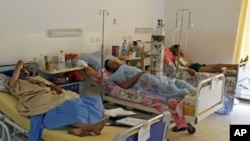
Rebel fighters, who were injured during fighting at Bab al-Aziziya, rest at Maitika Hospital, in Tripoli, Libya, August 27, 2011

Multimedia

TEXT SIZE - +

Gun battles are only part of the health crisis emerging in Libya’s capital, a city of one-and-a-half million people without running water.

Central Tripoli’s Zawiya Hospital has modern equipment. It lacks basics, though, such as running water and doctors.

Dressed in a blue smock, Mohammed El Busef stops on a busy corridor to say, “We need water. There is no water here in the hospital.’’

Busef is a fifth-year medical student. But when VOA visited, he was in charge.

“Most of the doctors are working 30-40 hours [at a time]. So they are sleeping right now,” he said.

A wounded man moves along the corridor, the latest in a steady flow of victims of the fighting.

“Most of the patients are here because they are wounded by snipers. Some by explosions,” said Busef.

On one bed a rebel fighter has bandaged shrapnel wounds in his right legs. His face has taken on a yellow color, but he is expected to survive.

Two rooms away is the unrefrigerated morgue, holding five bodies.

Across the city, hundreds of bodies still lie unburied in 30-degree temperatures [celsius].

In this modern city on the Mediterranean, services like water, electricity, Internet, telephone and garbage collection are erratic or non-existent.

Mahmoud Shammam, the information minister for Libya’s Transitional National Council, responded to complaints by warning residents “not to expect miracles.”

“About the bodies of some killed people, in some areas, the health authorities are taking care of that and we hope in a few hours, with the help of lot of councils, to solve that problem,” said Shammam.

From New York, U.N. Secretary-General Ban Ki-moon is launching a worldwide appeal for aid to Libya.

"Most immediately, we have asked for urgent humanitarian assistance, particularly as it relates to medical aid and basic public services, including water and sanitation and education,” said Ban.

Meanwhile, back in this sweltering hospital in downtown Tripoli, there is no water to spare to mop blood off the floors.

Busef, the medical student, said, “We gained our freedom by our blood.”

Judging by ongoing gun battles, hospitals in Tripoli may struggle with additional waves of wounded fighters in coming days.


James Brooke

A foreign correspondent who has reported from five continents, Brooke, known universally as Jim, is the Voice of America bureau chief for Russia and former Soviet Union countries. From his base in Moscow, Jim roams Russia and Russia’s southern neighbors.

You May Like

Experts Weigh In on Challenges of Closing Guantanamo Prison

Former chief military prosecutor at Guantanamo delivers petition to White House with more than 370,000 signatures, demanding facility be closed down immediately More

Karzai to Discuss Enhancing Defense Ties with India

Afghanistan looking for more military aid as it prepares for withdrawal of NATO forces by next year More

India, China Pledge to Overcome Border Tensions

Indian prime minister and Chinese premier attempt to move past tense standoff in the Himalayas during Delhi talks More

Burmese President Opens US Visit with VOA Town Hall Meeting

Ahead of his meeting with President Obama Monday, Thein Sein answered questions on human rights and economic development in his country More

This forum has been closed.
Comments
     
There are no comments in this forum. Be first and add one

Featured Videos

Your JavaScript is turned off or you have an old version of Adobe's Flash Player. Get the latest Flash player.
Video

Video US Oil Surge Could Impact Mideast Geopolitics

The United States will account for a third of new oil supplies over the next five years, and will become energy self-sufficient in 20 years, according to a new report by the Paris-based International Energy Agency (IEA). Although U.S. oil imports from Arab Gulf countries increased last year, analysts predict the U.S. will lose its dependence on Middle East imports, which is expected to have a huge impact on international relations and the balance of power. VOA's Henry Ridgewell reports.