



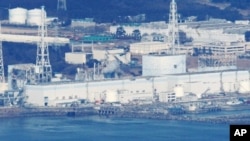
Japan's government is acknowledging time is running out to prevent a hazardous and significant spread of radiation into the atmosphere from the crippled Fukushima-1 nuclear power plant. Of utmost concern is one of the facility's damaged reactors (number 3) where water levels are believed to have fallen dangerously low in a pool where spent fuel rods are kept.
Air, ground assault
Japan's military and police have launched an air and ground assault to pour water on two crippled nuclear reactor buildings which are emitting radiation.
A pair of Self Defense Forces helicopters on Thursday began carrying out air drops on the nuclear plant in Fukushima prefecture. Officials at the plant said late Thursday they expect the government to make further efforts to cool the reactor with both helicopter drops and spraying.
Listen to Q&A with VOA's Steve Herman on spraying operation
The infrastructure for the reactors' cooling system was effectively destroyed by last Friday's tsunami. Explosions subsequently damaged several reactor buildings.
The risky air mission, which was aborted Wednesday because radiation levels were deemed too high, involves dropping 7.5 tons of water with each run to try to cool radioactive fuel rods. But live television video of the initial four air drops showed that much of the water appeared to be dispersed by winds.
Reactor 3 critical
The third reactor is considered the most critical. It uses mixed oxide fuel containing plutonium.
Defense Minister Toshimi Kitazawa, who gave the go-ahead Thursday for the helicopters to carry out the mission, acknowledges time is running out.
Kitazwa says the military believes that the air drops will help cool the fuel rods. He also confirmed that water pumps, provided by the U.S. military, are on their way to commence on-site spraying of water.
Kitazwa also says Japanese special purpose fire trucks and riot police squad water cannons are to be utilized. This is being viewed as a last-ditch attempt to prevent some of the hundreds of spent fuel rods from going critical. That would lead to significant amounts of radiation spreading to a wider area.
Tokyo Electric Power Company, which runs the plant, says it is replacing transmission lines to restore electricity to the nuclear plant as quickly as possible in order to provide an on-site source of energy to fuel a cooling system.
Chief Cabinet Secretary Yukio Edano says every effort is being made to bring the situation under control.
Obama offers more help
The top government spokesman also says Prime Minister Naoto Kan and U.S. President Barack Obama spoke for 30 minutes about the crisis. He says Mr. Obama informed the Japanese leader the United States is prepared to send more nuclear experts here, as well as providing assistance for Japan's earthquake and tsunami reconstruction efforts.
Both governments say Tokyo and Washington will continue to closely cooperate. But there is a public split between the two governments on the severity of the crisis.
Some U.S. government officials have been saying the situation at the Fukushima facility is more severe than Japan has acknowledged.
Evacuations
The US State Department on Thursday announced chartered aircraft would be available in Tokyo for Americans who desire to leave the country. It is also permitting the voluntary departure of embassy staff family members from Tokyo, Yokohama and Nagoya.
Some European countries have also urged their citizens to depart the capital, 200 kilometers from the nuclear plant.
The United States Embassy earlier in the day advised Americans within an 80-kilometer radius of the Fukushima nuclear facility to leave the area. Japan's evacuation zone extends only to 20 kilometers. About 200,000 people have left that zone. Those between 20 and 30 kilometers from the plant have been urged by the Japanese government to stay indoors
William Ide's video report on severity of nuclear crisis