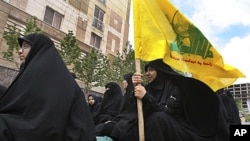



Hezbollah, the Lebanon-based militia group and political movement, used its al-Manar television channel to broadcast images supportive of anti-government protesters in Egypt and Tunisia. But analysts say the Shi'ite group's attitude toward the popular uprising in neighboring Syria has been very different, reflecting its close ties to the Syrian government.
As protesters demanded the ouster of authoritarian leaders in Egypt and Tunisia, Hezbollah's TV station, al-Manar, broadcast images and reports supportive of the demonstrators. But as one of the few media outlets allowed inside Syria to cover its uprising during the last two months, al-Manar has portrayed protesters there in a very different light.
Yasmine Dabbous, assistant professor of journalism and media studies at the Lebanese American University (LAU) says this apparent double standard has to do with the organization's relationship with the governments in these countries.
"In Egypt, it is very well known that Hezbollah had problems with the Egyptian government, so they supported the uprising against it - against Mubarak," noted Dabbous. "In Syria, on the other hand, they are supportive of the Assad regime, and so the coverage of the events is framed differently."
Professor Dabbous says there are several ways to portray an event and biases can show through, for example, through who reporters interview, how they edit video and by leaving out some facts and emphasizing others.
Imad Salamey, a political science professor at LAU, described some of al-Manar's recent coverage in Syria.
"They were going around in Syria and interviewing people and having people speak in favor of the regime and saying, it is normal life; there is nothing wrong; there is nothing going on; there are a few troublemakers - Israel and U.S. agents trying to stir trouble here and there, but now thank God, Assad has brought stability to the country," said Salamey.
Salamey said the Hezbollah channel also focused on stories that supported the Syrian government's claim that protesters are receiving support from outside the country, broadcasting pictures of what it described as confiscated weapons that had been smuggled from Lebanon, through Jordan and even the Israeli-controlled Golan Heights.
Al-Manar's coverage also emphasized pictures of dead Syrian soldiers and their funerals, while depicting the protesters as destructive and without legitimate grievances.
Professor Salamey notes that while the opposition movement in Syria is essentially secular, the government has tried to portray it as having extremist Islamic roots. He points out that if that were really the case, it would be an incentive for Hezbollah and its mouthpiece to support the demonstrators.
"You would assume that Hezbollah will be, if it was really true to its Islamic principles, to be supporting Islamists against the seculars. But no, strangely enough, you - and this is what exposed the claims of these organizations - we see them standing with the secular regime against supposedly some Islamists coming out of Syria," Salamey noted.
Repeated requests to al-Manar to discuss the channel’s coverage of the uprising in Syria were unsuccessful.
Hezbollah, whose name means "Party of God," styles itself as a resistance movement against Israel, Lebanon's southern neighbor. The group's two patrons are Iran and Syria.
Mohammad Chattah is a senior adviser to Lebanon's caretaker Prime Minister Saad Hariri. He says Hezbollah's close links with the Syrian government have taken shaped the content of news coverage by al-Manar.
"Syria was a close ally, in this case, because it was supportive of Iran and Hezbollah. And that is paramount," Chattah explained.
Chattah says that al-Manar’s stance is clear - it is backing its benefactor, the Syrian government.
Hezbollah Supportive of Egyptian, Tunisian Uprisings But Not Syria's