


High radiation levels at a crippled Japanese nuclear power plant continue to slow efforts to bring the situation under control. The Fukushima-1 complex has suffered repeated trouble since a massive earthquake and tsunami struck on March 11.
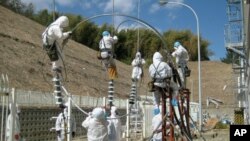
Workers at the Fukushima-1 nuclear plant are trying to remove pools of highly radioactive water that may have seeped from reactor cores or where used fuel rods are stored at four of the six reactors.
It is the latest challenge at the crippled facility, which has been beset by a series of hydrogen explosions and radiation leaks since the March 11 tsunami destroyed its cooling system. Since then, fire engines and concrete trucks have been used to pour thousands of tons of seawater onto the reactors and into the fuel rod pools.
The deputy director of the Nuclear and Industrial Safety Agency, Hidehiko Nishyama, says an effort is under way to replace sea water with fresh water. Nishiyama says it is a race against time because workers have to limit their exposure to the high radiation levels.
Nishiyama adds that Tokyo Electric Power Company has detected radioactive iodine 1,250 times the legal limit 300 meters offshore from the plant. That is a sharply higher level than recorded in previous days.
It remains unclear what is happening with the Number-3 reactor, which is fueled by a mix of uranium and plutonium.
The Japanese government says there is no evidence of a breach of the stainless steel chamber of the reactor core. Concern rose after two workers suffered skin burns Thursday when they were exposed to water in the reactor's turbine building. Authorities say the water was 10,000 times the level that would be expected within a reactor building.
Authorities say the high levels might be from the spent fuel pool lined with reinforced concrete. They note that pressure and the temperature inside the reactor core remain at levels far lower than what would further melt the core.
Prime Minister Naoto Kan, in remarks Friday evening, described the situation at the nuclear power plant as continuing to be "very grave and serious."
Vapor wafting from the facility has compelled Japanese broadcasters to add to their news programs regular reports of radiation levels for various cities. The announcer, on the Saturday noon newscast on NHK, says the reading for the city of Koriyama in Fukushima prefecture, at 7 a.m. was 3.40 micro-sieverts per hour, which he says is a higher radiation reading than previously recorded.
Koriyama is 60 kilometers west of the Fukushima nuclear plant. Homes within 20 kilometers of the plant have been evacuated. People who have remained in a zone between 20 and 30 kilometers have been advised to stay indoors to minimize their exposure to radiation.
A government spokesman Friday suggested that residents who live up to 30 kilometers away might want to voluntarily re-locate to places with better access to food and services.
The United States government has recommended that people stay at least 80 kilometers away from the troubled nuclear complex.
Japan's national police agency says the death toll from the March 11 earthquake and tsunami is above 10,000. About 17,000 people remain missing