
Today's steep rises in food prices, driven up by Russia's drought-devastated wheat harvest, present a worrying echo of the past for the authors of a new book.
In "Empires of Food," the authors say civilizations rise and fall on the backs of their food supplies, and the modern world is repeating mistakes that led earlier empires to fall.
Co-author Evan Fraser teaches sustainable development at the University of Leeds in England. But if he had his way, he would have liked to have been born in the Middle Ages.
"Being born somewhere around 1240, 1250 in Western Europe - relative to the centuries before or after that - was actually a really nice time," he says.
Medieval bounty
It was a time of high culture, when great cathedrals were built and renowned universities were founded. The society fed itself through a sophisticated continent-wide trading system, where each region specialized in a few crops and transported them to far-flung markets.
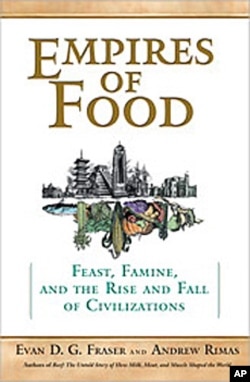
Fraser gives much of the credit to networks of monasteries across Europe, whose monks had spent the preceding few centuries cutting down Europe's forests with evangelistic zeal. He says that newly deforested land was tremendously fertile and productive.
"They created this huge amount of food that allowed people to move to the cities and created enough wealth in society that people could invest in universities and build cathedrals," he says. "So that was great."
But it wouldn't last. The soils wore out. Productivity declined. And then, Fraser says, "1315 comes along. The weather started to cool a bit. A bunch of rains destroy the crop. Fifteen percent of Europe dies suddenly over a four-year period in a series of catastrophic famines."
Where they went wrong
Europe had over-extended itself, he says. And it wasn't the first society to do so. In "Empires of Food," Fraser says this arc repeats itself over and over throughout history, from Mesopotamia to Rome to Han dynasty China and beyond: Civilizations grow when the weather is good and soil is fertile. Their farmers specialize in a few crops and trade for the rest of their needs with faraway suppliers.
But farmers eventually exhaust the soil. Climate changes. And when crops fail, specialized agriculture and faraway suppliers become a liability.
And Fraser says we're doing it all over again today.
"The reason we wrote the book," he says, "is that we haven't learned these lessons. The modern world is committing the same series of mistakes that the Sumerians, or the ancient Chinese, or the ancient Romans, or the medieval monks all made."
Fraser is among those who say modern agriculture's reliance on chemical fertilizers, pesticides and vast fields of single crops is not sustainable. With the predictions for climate change, he says, it's time to make some changes. Those include a shift away from globalized, industrialized agriculture toward more organic and local production methods.
Food crises past and present
He says the sharp rise in food prices in 2008 and the food riots that followed remind him of the decades preceding the bloody French Revolution in the 18th century.
"Historically speaking, when these things are allowed to progress unchecked, one of the first symptoms is inflation and one of the last and most extreme symptoms is civil war," he says.
It doesn't always end that way, he adds, but 2008 should serve as a warning.
Scientific solution
"Some of the points he makes are very valid," says Fran Pierce, professor of crop science at Washington State University and president of the American Society of Agronomy.
"We're not going to have more water than we have right now," he says. "We're not going to have more land than we have right now. Our fertilizers are not infinite. And our fuel and energy sources are not going to be there the way they are right now. Those are all true. He's correct there."
But, Pierce says, Fraser left out an important factor. "He doesn't talk about what we've been able to do when we've applied scientific principles to the production of food and fiber and feed."
Pierce notes that scientists made major advances in food production in the last half-century that averted famine in large parts of the world. And we're more technologically advanced than ever before, he says. So he's hopeful that science can help avert the next major famine and keep our modern societies from suffering the fate of food empires of the past.