


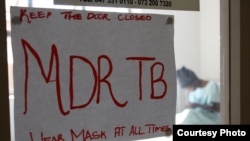
Health ministers from Swaziland and South Africa have agreed to radically change the diagnosis and treatment of the co-epidemic of TB/HIV in their countries. They made their comments at a press conference held on March 20 in Johannesburg.
Doctors Without Borders, also known as MSF, said TB deaths in southern Africa account for 40 percent of all TB deaths globally, and it remains the leading cause of death for people with HIV.
In addition, death rates are highest among TB patients with multi-drug, or MDR, resistance to tuberculosis because fast and accurate diagnosis is rarely available.
Dr. Marc Gastellu Etchegorry, MSF’s international medical secretary, said the agreement to tackle TB and HIV in a new and innovative way is a real priority not only for the world, but particularly for southern Africa.
"It is a priority because we have a lot of cases by now, and TB is a very good illustration of that. But one of the problems is that the patients have difficulties in accessing the treatment. And as we have a lot of people who are moving from one place to another, or one country to another, it is really important to find a new means to deliver the treatment to them," explained Gastellu Etchegorry.
He said the commitments made by Swaziland and South Africa highlighted the importance of centering treatments on the patient and not on the disease.
This, said Gastellu Etchegorry hopefully will be translated into action.
"The action is that we have to deliver diagnosis and treatment close to the patients, build the structure for that," he explained. "We also have to give the right documents to the patients so if they move they will be able to follow their treatment everywhere. And this means they have to be harmonized."
Gastellu Etchegorry emphasized the importance of building health structures that are able to diagnose and treat patients suffering from both TB and HIV at the same time.
"We have to be on the spot where patients are," he said. In addition, the action plan would involve the support of local authorities and governments to help bring about changes for people with TB/HIV.
The initiative to bring about a more vigorous response to deal with TB/HIV and MDR-TB is being funded by the Global Fund, along with other partnerships, and the mining sector.
Gastellu Etchegorry says it is not just a matter of money, but of political willingness to bring about radical change for the benefit of the patient.
Doctors Without Borders, also known as MSF, said TB deaths in southern Africa account for 40 percent of all TB deaths globally, and it remains the leading cause of death for people with HIV.
In addition, death rates are highest among TB patients with multi-drug, or MDR, resistance to tuberculosis because fast and accurate diagnosis is rarely available.
Dr. Marc Gastellu Etchegorry, MSF’s international medical secretary, said the agreement to tackle TB and HIV in a new and innovative way is a real priority not only for the world, but particularly for southern Africa.
"It is a priority because we have a lot of cases by now, and TB is a very good illustration of that. But one of the problems is that the patients have difficulties in accessing the treatment. And as we have a lot of people who are moving from one place to another, or one country to another, it is really important to find a new means to deliver the treatment to them," explained Gastellu Etchegorry.
He said the commitments made by Swaziland and South Africa highlighted the importance of centering treatments on the patient and not on the disease.
This, said Gastellu Etchegorry hopefully will be translated into action.
"The action is that we have to deliver diagnosis and treatment close to the patients, build the structure for that," he explained. "We also have to give the right documents to the patients so if they move they will be able to follow their treatment everywhere. And this means they have to be harmonized."
Gastellu Etchegorry emphasized the importance of building health structures that are able to diagnose and treat patients suffering from both TB and HIV at the same time.
"We have to be on the spot where patients are," he said. In addition, the action plan would involve the support of local authorities and governments to help bring about changes for people with TB/HIV.
The initiative to bring about a more vigorous response to deal with TB/HIV and MDR-TB is being funded by the Global Fund, along with other partnerships, and the mining sector.
Gastellu Etchegorry says it is not just a matter of money, but of political willingness to bring about radical change for the benefit of the patient.