


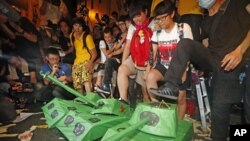
HONG KONG — Chinese President Hu Jintao wrapped up his three-day tour of Hong Kong Sunday, marking the 15th anniversary of the return of the former British colony to Chinese rule. Up to half a million people took to the streets to protest against what they see as the erosion of social and political freedoms under Chinese rule.
British colonial rule is not missed in Hong Kong. But China’s creeping influence, exercised through the Mainland Liaison Office, is viewed with increasing alarm, says Eric Lai of the Civil Human Rights Front, organizer of Sunday’s march.
“Civil liberties are narrowing after 15 years, since both the government and liaison office implement lots of carrot and stick strategies, for instance asking the media to censor itself, and restricting freedom of assembly and protest in Hong Kong,” he said.
During President Hu’s visit, Chinese tanks and rocket launchers were seen for the first time in Hong Kong, symbolizing Beijing’s now absolute control over this city, with a population of seven million.
In scenes reminiscent of a Tiananmen Square military parade, Hu reviewed People’s Liberation Army troops of the normally publicity-shy Hong Kong garrison just hours after his arrival.
The president said he wished to meet the Hong Kong people during his tour, to better understand their lives and aspirations.
However, rolling protests marked the entirety of his visit. On Saturday police fired pepper spray at hundreds of demonstrators outside the president’s hotel.
They gathered to demand an investigation into last month’s suspicious death of labor activist and 1989 Tiananmen Square protester Li Wangyang.
In previous years, protests in Hong Kong could be introspective affairs, observes pan-democrat legislator Audrey Eu, whose micro blog site was shut by censors last week. Li’s death has changed that.
“It is a rude awakening because this is not history [like the Tiananmen massacre]. It is very much the present and we are part of China," said Eu. "So this particular incident brought home to Hong Kong people that human rights incidents on the Mainland are very much a matter for Hong Kong as well.”
Civic action culminated Sunday with one of the largest protest marches in recent memory. Organizers estimate 400,000 people took to the streets to express their discontent on a range of issues.
Of popular concern is the city’s growing wealth gap - now the widest in Asia, the government confirmed last month - and China’s perceived interference in Hong Kong’s chief executive election.
This contest in March saw Leung Chun-ying, 57, appointed to Hong Kong’s top political office by a committee of 1,200 pro-Beijing tycoons. Hu accepted Leung’s pledge of allegiance at an inauguration ceremony Sunday morning.
Chairman of the League of Social Democrats, Andrew To, argues Leung is merely a puppet leader.
“How can he rule Hong Kong? This is the problem of the central government - not letting the Hong Kong people have universal suffrage," said To. "Let us have the chance to elect our chief executive. He has no legitimacy at all.”
Leung already appears beleaguered. Questions are being asked about his integrity in light of allegations of illegal building work at his home on the exclusive Victoria Peak.
Leung’s new Cabinet has also been lambasted. It contains just one woman, and 14 officials who served under his unpopular predecessor Donald Tsang.
Aware that public support for Beijing is at an historic low in the city, Hu spoke in conciliatory terms before his departure.
He vowed China would uphold the One Country, Two Systems formula, and suggested Hong Kong’s next chief executive would be elected by universal suffrage in 2017 - a policy China has stalled on since it was mooted by the National People’s Congress in 2007.
Hu’s speech was interrupted by yet another protester yelling for an end to one-party rule - an incident edited from state television’s “live” transmission, which was in fact transmitting on a 20-second delay.
Hu will soon retire. Should his legacy be universal suffrage in Hong Kong by 2017, the city’s next leader would be the first to be democratically elected in almost 200 years of either British or Chinese rule - and the first democratically elected senior official in modern China.
British colonial rule is not missed in Hong Kong. But China’s creeping influence, exercised through the Mainland Liaison Office, is viewed with increasing alarm, says Eric Lai of the Civil Human Rights Front, organizer of Sunday’s march.
“Civil liberties are narrowing after 15 years, since both the government and liaison office implement lots of carrot and stick strategies, for instance asking the media to censor itself, and restricting freedom of assembly and protest in Hong Kong,” he said.
During President Hu’s visit, Chinese tanks and rocket launchers were seen for the first time in Hong Kong, symbolizing Beijing’s now absolute control over this city, with a population of seven million.
In scenes reminiscent of a Tiananmen Square military parade, Hu reviewed People’s Liberation Army troops of the normally publicity-shy Hong Kong garrison just hours after his arrival.
The president said he wished to meet the Hong Kong people during his tour, to better understand their lives and aspirations.
However, rolling protests marked the entirety of his visit. On Saturday police fired pepper spray at hundreds of demonstrators outside the president’s hotel.
They gathered to demand an investigation into last month’s suspicious death of labor activist and 1989 Tiananmen Square protester Li Wangyang.
In previous years, protests in Hong Kong could be introspective affairs, observes pan-democrat legislator Audrey Eu, whose micro blog site was shut by censors last week. Li’s death has changed that.
“It is a rude awakening because this is not history [like the Tiananmen massacre]. It is very much the present and we are part of China," said Eu. "So this particular incident brought home to Hong Kong people that human rights incidents on the Mainland are very much a matter for Hong Kong as well.”
Civic action culminated Sunday with one of the largest protest marches in recent memory. Organizers estimate 400,000 people took to the streets to express their discontent on a range of issues.
Of popular concern is the city’s growing wealth gap - now the widest in Asia, the government confirmed last month - and China’s perceived interference in Hong Kong’s chief executive election.
This contest in March saw Leung Chun-ying, 57, appointed to Hong Kong’s top political office by a committee of 1,200 pro-Beijing tycoons. Hu accepted Leung’s pledge of allegiance at an inauguration ceremony Sunday morning.
Chairman of the League of Social Democrats, Andrew To, argues Leung is merely a puppet leader.
“How can he rule Hong Kong? This is the problem of the central government - not letting the Hong Kong people have universal suffrage," said To. "Let us have the chance to elect our chief executive. He has no legitimacy at all.”
Leung already appears beleaguered. Questions are being asked about his integrity in light of allegations of illegal building work at his home on the exclusive Victoria Peak.
Leung’s new Cabinet has also been lambasted. It contains just one woman, and 14 officials who served under his unpopular predecessor Donald Tsang.
Aware that public support for Beijing is at an historic low in the city, Hu spoke in conciliatory terms before his departure.
He vowed China would uphold the One Country, Two Systems formula, and suggested Hong Kong’s next chief executive would be elected by universal suffrage in 2017 - a policy China has stalled on since it was mooted by the National People’s Congress in 2007.
Hu’s speech was interrupted by yet another protester yelling for an end to one-party rule - an incident edited from state television’s “live” transmission, which was in fact transmitting on a 20-second delay.
Hu will soon retire. Should his legacy be universal suffrage in Hong Kong by 2017, the city’s next leader would be the first to be democratically elected in almost 200 years of either British or Chinese rule - and the first democratically elected senior official in modern China.