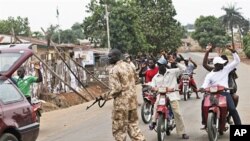



Human Rights Watch wants Nigerian leaders to ensure that security forces act responsibly in stopping post-electoral violence. Supporters of a former military ruler have clashed with riot police in protests against the election of President Goodluck Jonathan.
President Jonathan is sending more security forces to some northern states where Muslim supporters of defeated presidential candidate Muhammadu Buhari attacked churches, homes and police stations, sparking reprisal attacks by Christians.
"Sadly, some misguided elements do not share in the spirit of our democratic achievement," said Jonathan. "They formed into groups of miscreants and struck with deadly and destructive force in some parts of the country. They killed and maimed innocent citizens. They set ablaze business premises, private homes, and even places of worship."
Buhari says the vote was rigged through electoral commission computers and is calling on his supporters to stay calm while his party challenges the results in court.
President Jonathan says these disturbances are more than mere political protest. He says they are clearly aimed at frustrating Nigeria's remaining elections, and that is not acceptable.
"The perpetrators of these dastardly acts of violence and all those who seek to continue to breach the peace and stability of this nation must be fished-out [exposed] and made to face the full weight of the law," Jonathan stated.
As security forces move to stop violence that the Red Cross says has already displaced more than 40,000 people, Human Rights Watch says the Jonathan government must ensure that those forces do not make things worse by using excessive force.
"The Nigerian security forces have a history of carrying out abuses when responding to sectarian clashes or responding with excessive use of force," said Eric Guttschuss, a researcher for Human Rights Watch in Nigeria. "The first steps that really need to be taken are that within these communities that have been affected by rioting and protests, they need to beef-up security and ensure that all citizens within those locations are provided security in a neutral manner to ensure that the security forces are not using excessive use of force while responding to these clashes."
Media reports say more than 100 people were killed in post-election violence, though officials have declined to give a death toll for fear of prompting more attacks. The International Criminal Court says it is investigating whether crimes committed during the unrest are within its jurisdiction.
Nigeria's electoral commission is delaying state-wide voting in the mainly-Muslim states of Kaduna and Bauchi. Electoral commission Chief Attahiru Jega says he hopes that will allow for the "further cooling of tempers and for the security situation in those states to continue to improve."
Gubernatorial elections in other states will go ahead as scheduled on Tuesday.
Human Rights Watch Warns Against Abuses in Nigeria