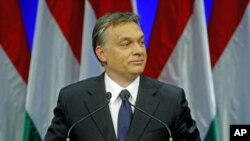
A defiant Hungarian Prime Minister Viktor Orban is defending his financially troubled nation's new constitution and related laws, saying those criticizing it are motivated by greed and want to keep Hungary indebted. Orban's comments come as he faces mounting criticism over perceived autocratic legislation and after his Romanian counterpart resigned amid widespread protests there.
Enjoying the applause of his ruling party faithful while standing in front of a long row of Hungarian flags in Budapest's 'Millennium Park' complex, Orban took time out to defend his embattled government's record.
In his annual state-of-the nation address, Orban indirectly condemned the European Union's executive, the European Commission, which is taking legal steps against a new constitution and related legislation, saying they undermine the independence of Hungary's central bank and the judiciary, and do not respect data privacy principles.
Orban has placed allies in key institutions, such as authorities supervising media, who can take steps against journalists if they violate what critics say are somewhat unclear requirements of balanced reporting.
Rights groups and former dissidents of the Communist-era also have expressed worries that only 14 out of hundreds of religious groups are recognized by the state as churches. Other critics claim the constitution imposes a conservative ideology on the country. The constitution was only approved by lawmakers from the governing parties and went into effect on January 1 of this year.
A defiant Orban told an enthusiastic crowd that he stood by his actions.
He said that the new constitution will be defended "by all means" because it offers good solutions to Hungary's problems. Orban said that the critics are financially motivated by interests in Hungary's markets and resources, and want to keep the nation indebted and dependent on loans. He explained that "Debt is a good deal, if you are on the right end of the stick. Let's not be naive - in truth, this is their problem with the new constitution."
The prime minister's attempt to quell his critics comes amid economic uncertainty in the nation, which is seeking some $26 billion in financial assistance from the European Union and the International Monetary Fund.
Meanwhile, in Romania, students and the elderly, braved winter weather in recent weeks to demand the resignation of the government, amid anger over austerity measures.
At times there were battles with police in the capital Bucharest, where in 1989 Romania witnessed a revolution that toppled Communist dictator Nicoleau Ceausescu.
Until the last moment, Prime Minister Emil Boc tried to defend an increase in the sales tax from 19 percent to 24 percent and his government's decision to slash public workers' salaries by one fourth to reduce the budget deficit.
He said they were put in place in exchange for a desperately needed $26 billion loan from the IMF, EU and World Bank in 2009, to help pay salaries and pensions after Romania's economy shrank by more than 7 percent.
But with the critics getting louder, Boc acknowledged in televised remarks this week it was time for new leadership.
The Romanian prime minister said he and his government will resign immediately to protect the stability of the country. Boc added that he was resigning "to ease the social situation" - referring to weeks of protests in Romania over austerity measures that he introduced in 2010.
Boc, who became prime minister in 2008, said the stability of the country must be defended at all costs. He urged Romania's quarreling politicians to be mature and rapidly vote for a new government. But he defended his record, saying he has taken "difficult decisions thinking about the future of Romania, not because he wanted to, but because he had to."
President Traian Basescu named the current head of Romania's foreign intelligence service, Mihai Razvan Ungureanu, to be interim prime minister pending the approval of a new government. Parliament is scheduled to vote on the cabinet Thursday. If it does not approve a new executive in 60 days, parliament will be dissolved and new elections will be called.
Analysts say the ruling coalition and its partners from minorities, however, have enough votes to elect a new government ahead of a parliamentary election to be held by November at the latest.
Back in Hungary, there have been anti-government protests as well, although at least 100,000 also supported Prime Minister Orban in a separate rally that the opposition claimed resembled those in Communist North Korea.
Yet, Orban is being pressured by impoverished Hungarians.
Dozens of people have begun marching from Borsod County, one of the country's poorest, to Budapest hoping to bring the plight of their region to the government's attention in what they dubbed “the March for Bread and Work.”
They marched some 180 kilometers despite a cold front that has killed hundreds of people across Eastern Europe, including more than a dozen in Hungary.
Hungary's center-right government has been criticized for legislation under which homeless people who are found sleeping outdoors can face heavy fines of up to $600 or even prison terms.
Hungary's PM Condemns International Critics Amid Economic Uncertainty
- By Stefan Bos