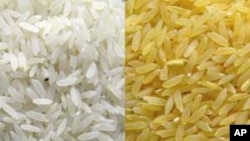



As part of VOA's special coverage of food and hunger issues, we are putting the spotlight on the Geneva-based Golden Rice Project. The group has come up with a creative yet controversial way to pack more nutrients into grains of rice. Its team has used genetic engineering to make "Golden Rice," a strain of rice that contains pro-vitamin A, a crucial ingredient in healthy immune systems.
Project manager Adrian Dubock says this strain of "super rice" could benefit millions of hungry and malnourished people. But, he tells VOA, it has not yet hit the market because there is still opposition to manipulating the genetic makeup of this essential grain.
Why did you produce Golden Rice?
Vitamin A deficiency kills around 6,000 people every day, affecting their immunity. So normal childhood diseases, for example, become lethal. About half of the world's population everyday eats rice, that's about three billion people. And in some of the poorest populations, about 80 percent of the carbohydrate intake is from white rice. White rice doesn't contain anything really other than carbohydrates, so they are short of minerals. Vitamin A deficiency is the biggest problem, and if they were able to have a balanced diet of vegetables and animal products, they wouldn't suffer from that. But unfortunately, for a variety of reasons, often to do with poverty, and sometimes to do with religion, they don't have enough animal products or colored vegetables or fruits to allow them to have normal vitamin A status.
Why hasn't this been approved for consumption around the world?
We are moving towards regulatory clearance of it, initially in the Philippines. There is a lot of politics around the technique of genetic modification, largely as a result of an international protocol agreed between nations back in 1992, when very little was known about genetic modification. And those regulations have resulted in national regulations within the scope of those international regulations, which creates some suspicion in certain populations about the technology. Why would you need to regulate it so much if it wasn't something to be concerned about? It's that kind of idea. That suspicion has allowed some groups who are opposed to the technology to build on that suspicion and cause political concern about the technology.
Many international organizations - for example, the scientific academies of all of the major countries in the world - have come out and said there is no problem with genetic modification per se as a technology for either the health or the environment anywhere in the world.
Many people are uncomfortable with issues of intellectual property protection, with issues of corporate control of food supplies, with issues of the possibility of creating new dependencies, especially in developing countries. And many people think genetic modification as a technique may be somehow a "Trojan horse" to allow private sector companies to create these new dependencies and control food supplies. This is a very narrow view of the technology and it is incorrect, but nevertheless some people hold to it.
What is the next step?
For the last four or five years, the project has been a breeding project, putting the Golden Rice trait into varieties of rice which are preferred by and grown in the conditions of Asia, which is where most of the Vitamin A deficiencies occur in rice-consuming populations. It is a fact of this project that there's no profit involved for anybody. It's a totally humanitarian project. The trait will be made available free of charge to those growers and consumers who want to have it available to them. And our initial work in developing countries has suggested that there is no concern in the populations that are affected by Vitamin A deficiency about either its color or its method of production. They're much more interested in providing their families with good nutrition. And for them, cost is very important.
Hunger in Focus: Three Questions on Golden Rice