


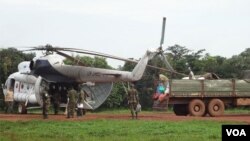
A new report says military operations to hunt down LRA rebels in Central Africa face many logistical and intelligence-gathering challenges. In the meantime, the rebels continue to attack civilians.
About 1500 Ugandan soldiers make up the bulk of the forces pursing the Lord’s Resistance Army. And all those troops may not be deployed in the field at the same time.
A field report by the Enough Project says the Ugandan army can roam the jungles for weeks or months before making contact with the rebels.
Kasper Agger, who wrote the report, was embedded with the Ugandan army in August as it traveled from South Sudan to Central African Republic.
“It was a unique opportunity to be able to actually go deep into the jungle and spend several days with the soldiers on the ground, who are actually chasing and looking for the LRA, to really get an insider’s view of the challenges that they are facing,” he said.
Agger said LRA rebels are able to hide in a vast and remote area of jungle.
“Just finding tracks in the jungle that possibly could be LRA is a huge challenge in the first place. And then once they find a track of the rebels and they start pursuing them, they can even end up pursuing some of the other militias or rebel groups that operate in the area, like Janjaweeds or poachers from Sudan or it can be even local hunters. You can’t distinguish the traces in the jungles between the different groups,” he said.
He said that the Ugandan army – and 100 U.S. Special Forces advisors – have a good idea where the LRA operates. But pinpointing the location and then attacking can be difficult.
“We have to recognize that the LRA is able to live off the land. They can prey on civilians. They can do hunting. It’s actually kind of easy for them to survive in these remote jungles, whereas the UPDF will have to carry their supplies. They’ll have to rely on food drops from helicopters. And it’s just an extreme logistical nightmare basically to operate out in these areas. When I was out there, some of their tracking teams had gone without food for four days because they were not able to supply them and they couldn’t reach them with helicopters because they were too deep in the jungle,” he said.
Agger recommended several things to improve the situation. First, ramp up aerial and human intelligence in Central Africa and deploy more troops in remote areas. Next, he said, there should be more defection initiatives. These are programs that encourage fighters to leave the LRA by offering them ways to reintegrate into society. Agger says if no jobs are available, it’s an easy choice for fighters to remain with the rebel group.
He said that American advisors have reenergized efforts to track down the LRA and helped to coordinate intelligence with regional militaries.
It’s estimated there are about 300 to 400 armed rebels, plus 500 to 700 hundred women, children and recent abductees forced to work for them. As for LRA leader Joseph Kony, it’s thought he may be based in Sudan.
“Kony is a very intelligent man. We should not underestimate his intelligence and his awareness of the world around him. What we’re increasingly hearing from people who escaped from the LRA is that he has sought refuge in South Darfur in a disputed area and that he is probably getting some kind of assistance from the Sudanese army. And that’s a huge challenge to the end game of this mission – how to bring the Sudanese government into some kind of solution of this problem. And we really have to try and sell this as a political win for Bashir and the Khartoum government,” he said.
Agger does not believe Sudanese president Bashir has direct control over Kony. But Kony may have good relationships with Sudanese military commanders, who help rebels operate in Central African Republic, an area rich in minerals.
Top LRA commanders are still at large. Many are wanted by the International Criminal Court for war crimes and crimes against humanity stemming from their many years in northern Uganda. In his field dispatch, Agger warned that the situation “is not sustainable,” adding that Ugandan troops and U.S. advisors will not be deployed indefinitely.
Agger also produced a video of his experience.
About 1500 Ugandan soldiers make up the bulk of the forces pursing the Lord’s Resistance Army. And all those troops may not be deployed in the field at the same time.
A field report by the Enough Project says the Ugandan army can roam the jungles for weeks or months before making contact with the rebels.
Kasper Agger, who wrote the report, was embedded with the Ugandan army in August as it traveled from South Sudan to Central African Republic.
“It was a unique opportunity to be able to actually go deep into the jungle and spend several days with the soldiers on the ground, who are actually chasing and looking for the LRA, to really get an insider’s view of the challenges that they are facing,” he said.
Agger said LRA rebels are able to hide in a vast and remote area of jungle.
“Just finding tracks in the jungle that possibly could be LRA is a huge challenge in the first place. And then once they find a track of the rebels and they start pursuing them, they can even end up pursuing some of the other militias or rebel groups that operate in the area, like Janjaweeds or poachers from Sudan or it can be even local hunters. You can’t distinguish the traces in the jungles between the different groups,” he said.
He said that the Ugandan army – and 100 U.S. Special Forces advisors – have a good idea where the LRA operates. But pinpointing the location and then attacking can be difficult.
“We have to recognize that the LRA is able to live off the land. They can prey on civilians. They can do hunting. It’s actually kind of easy for them to survive in these remote jungles, whereas the UPDF will have to carry their supplies. They’ll have to rely on food drops from helicopters. And it’s just an extreme logistical nightmare basically to operate out in these areas. When I was out there, some of their tracking teams had gone without food for four days because they were not able to supply them and they couldn’t reach them with helicopters because they were too deep in the jungle,” he said.
Agger recommended several things to improve the situation. First, ramp up aerial and human intelligence in Central Africa and deploy more troops in remote areas. Next, he said, there should be more defection initiatives. These are programs that encourage fighters to leave the LRA by offering them ways to reintegrate into society. Agger says if no jobs are available, it’s an easy choice for fighters to remain with the rebel group.
He said that American advisors have reenergized efforts to track down the LRA and helped to coordinate intelligence with regional militaries.
It’s estimated there are about 300 to 400 armed rebels, plus 500 to 700 hundred women, children and recent abductees forced to work for them. As for LRA leader Joseph Kony, it’s thought he may be based in Sudan.
“Kony is a very intelligent man. We should not underestimate his intelligence and his awareness of the world around him. What we’re increasingly hearing from people who escaped from the LRA is that he has sought refuge in South Darfur in a disputed area and that he is probably getting some kind of assistance from the Sudanese army. And that’s a huge challenge to the end game of this mission – how to bring the Sudanese government into some kind of solution of this problem. And we really have to try and sell this as a political win for Bashir and the Khartoum government,” he said.
Agger does not believe Sudanese president Bashir has direct control over Kony. But Kony may have good relationships with Sudanese military commanders, who help rebels operate in Central African Republic, an area rich in minerals.
Top LRA commanders are still at large. Many are wanted by the International Criminal Court for war crimes and crimes against humanity stemming from their many years in northern Uganda. In his field dispatch, Agger warned that the situation “is not sustainable,” adding that Ugandan troops and U.S. advisors will not be deployed indefinitely.
Agger also produced a video of his experience.