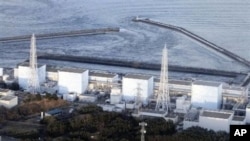



The head of the International Atomic Energy Agency, or IAEA, said Monday in Vienna that despite problems at two nuclear power plants in Japan stemming from last week's earthquake and tsunami, there is no indication of a reactor meltdown. But the fluid situation and fears of a possible meltdown are raising concerns.
IAEA Director General Yukiya Amano sought to calm fears about the release of radioactive gas into the air, following two explosions at the Fukushima nuclear power plant, some 200 kilometers north of Tokyo. "Despite the hydrogen explosions, reactors vessels and containment vessels stayed in tact. As a result, the release of radioactivity was limited," he said.
Amano described the many layers of protection at the Japanese plant. "The nuclear reactors BWR [i.e., boiling water reactor] have multiple safety measures. The nuclear core is contained in reactor vessels that are made of higher [grade] steel. Then the reactor's vessel is contained in a primary containment vessel that is made of concrete," he said.
Japan expert Daniel Aldrich of Purdue University in the U.S. state of Indiana says the situation at the stricken plant is not as serious as the 1986 nuclear power accident at Chernobyl in what is now Ukraine. "This is a smaller scale meltdown, where the fuel rods themselves have not been cooled down by water or normally by other cooling fluids. So in this case, it means the fuel gets so hot, the rods themselves melt. And if uncontrolled, this could build into a larger meltdown. So right now, to our knowledge, this is only a partial meltdown," he said.
But nuclear engineer David Lochbaum with the Union of Concerned Scientists cautions that it is difficult to detect a meltdown. "There's not an annunciator; there's not an alarm window or a computer print out that says, 'I've experienced a core meltdown.'"
A partial core meltdown occurs when nuclear fuel is not cooled for several hours and begins to melt. A full nuclear meltdown occurs when the fuel in the core melts and falls to the bottom of the reactor's containment vessel. If the heat ruptures the vessel, it could result a large and violent release of radiation with serious health effects.
Expert Daniel Aldrich says that so far, the release of radiation at the Fukushima plant has been similar to the 1979 accident at Three Mile Island in the United States rather than the Chernobyl disaster, the worst nuclear accident in history.
"Well we know from Chernobyl, it was a tremendously large, full meltdown, we had there in Russia. It's possible for radioactivity to travel literally thousands of miles in the atmosphere. From Three Mile Island though, which I think is a better to comparison to what's going on now, the maximum distance we think it traveled was just a few miles. In fact, Three Mile Island never had provable health effects on local residents there," he said.
But physicist Edwin Lyman with the Union of Concerned Scientists says the radiation exposure levels of three U.S. helicopters crews flying far from the Fukushima plant, should be cause for concern. "I think it's not a surprise that there would be a propagation of some fission products as far as 100 miles [from the plant], but what is surprising is the extent of the dose rate that I heard was attributed to the airman, which seems to be a little bit higher than I would have been expected at this point," he said.
About 200,000 people have been evacuated from areas around Fukushima and other troubled nuclear power stations. About 600 people still in homes near the Fukushima plant have been advised to remain indoors.
IAEA: No Indication of Nuclear Reactor Meltdown in Japan