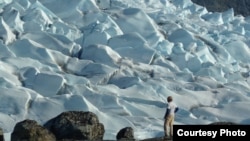
University of Wisconsin geologist Anders Carlson looking at an ice margin in south Greenland that is changing from being marine based to land based and thus slowing down and becoming more predictable. (Photo: Rob Hatfield, Oregon State University)
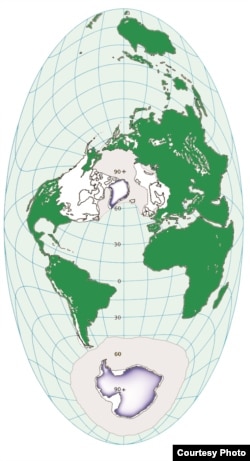
When the climate began to warm during the last Ice Age about 23,000 years ago, much of the Northern Hemisphere was covered in ice.
In two new studies published this week in Nature Geoscience, researchers describe how ice sheets behaved in the past could help scientists better predict what might happen to them in a warmer world of our future.
University of Wisconsin geologist Anders Carlson studies ice sheet melt from land and ocean sediment cores. His study describes what prehistoric Earth was like in North America and Northern Europe some 140,000 years ago.
“What we found in this paper was that ice that’s resting on land it responded very quickly to the warming climate, but then it didn’t retreat really rapidly. It kind of chugged along and slowly melted like an ice cube if you put a hair dryer on it,” Carlson says, adding that was not the case with ice sheets floating on the ocean. “Marine based ice sheets behave unpredictably. They may not do anything for a while, and then they all of a sudden respond very abruptly. They can rapidly disappear.”
Greenland and Antarctica hold the Earth’s last remaining ice sheets. In July, satellite data showed that 97 percent of the surface of the Greenland ice sheet had turned to slush over four days, a rate faster than at any time in recorded history. According to Carlson, it might be responding rapidly to small changes in temperature, similar to what he saw in the prehistoric record of ice sheets on land.
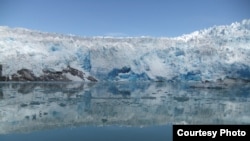
This marine-based glacier in the area of Greenland is retreating into land. (Photo: Kelsey Winsor/UW-Madison)
“But that said, they haven’t catastrophically collapsed in the past either to rapidly raise sea level in the time scale that humans would care about, that we would be hard pressed to adapt to.” Carlson says the Antarctic marine-based ice sheet is less predictable. “What this would say from the past is that these ice sheets, well they may not do anything for a bit. But then if you want to catastrophically raise sea level like on the orders of a meter or two in human lifetime, there is prehistoric precedent for that happening.”
A second paper in Nature Geoscience looks back 12,000 to 7,000 years to when massive ice sheets still covered the high latitudes of the Northern Hemisphere. At that time, the global climate was roughly comparable to what it is today and glaciers were melting.
Earth during the Ice Age 23,000 years ago with large ice sheets covering the Northern Hemisphere. (Credit: Anders Carlson)
The study describes abrupt sea level jumps - from one-half to two meters - from melting glaciers.
"What happens when you suddenly drain these massive amounts of fresh water into the ocean? It’s going to change ocean circulation,” says co-author Torbjorn Tornqvist, an Earth scientist at Tulane University in Louisiana.
Today, rapid melting from the Greenland ice sheet would send massive amounts of fresh water into the North Atlantic Ocean, changing the marine environment.
“But it will also lead to potentially higher precipitation rates in the same region, which could also lead to fresher surface waters in the North Atlantic," Tornqvist says. "So we need to understand whether those types of changes could potentially be capable of triggering these kinds of abrupt climate events.”
Tornqvist adds that understanding how abrupt climate changes affect Earth’s geologic past can help design climate models that can better predict the future.