


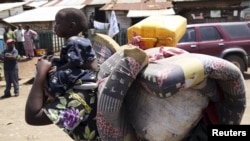
The International Organization of Migration, IOM, said it is stepping up measures to respond to the humanitarian crisis in eastern Democratic Republic of Congo’s North Kivu province.
Staff on the ground say until now insecurity in the area has made it very difficult to reach people who are displaced because of the conflict. However, M23 rebels have left the city of Goma, and now aid will be able to be moved in.
Chris Lom, a spokesperson for IOM in Geneva said one of the latest efforts right now is to erect shelters to house some of the displaced who have been residing in school buildings.
"What has happened now is the M23 rebels have withdrawn. IOM and other humanitarian agencies are now moving in as the security situation improves to encourage these people to move into alternative shelter," explained Lom.
The IOM said it received funding to build emergency shelters for some of the internally displaced people, IDPs, at the largest spontaneous displacement sites in Eastern Democratic Republic of Congo.
"These emergency shelters are really the tip of the iceberg. We’re going to be providing shelter for roughly 800 people with the donation provided by the Swiss Development and Cooperation Agency, SDC. This will allow people to essentially move out of schools, to allow the community to get back to some sort of semblance of normality, particularly the kids, of course. And experience has shown the best way to restore normality in post-conflict situations for children is to get them back into school,” explained Lom.
Among other efforts to help the IDPs, the IOM is working in coordination with other humanitarian agencies to address the needs of IDPs in spontaneous sites in what they describe as a “3-axis strategy.”
Lom said this strategy was formalized by the 149-member states at their council meeting in November of this year. He described the strategy as something of a framework to cope with displacement during crises. He explained the strategy consists of three parts.
“The first is information-gathering and mapping of how many people are displaced, where they are, and what they need. And the second part of it is how to coordinate the work of the different humanitarian agencies trying to help people in different spontaneous displacement sites, and the host communities. The third strategy is essentially to strengthen the resilience of displaced people in the communities so that if the situation deteriorates in the future, they’ll be better equipped to deal with it," he said.
Lom added that the first step towards this process is to get donor funding, and they hope with this initial seed funding from Switzerland, other members of the international community will be encouraged to participate.
Staff on the ground say until now insecurity in the area has made it very difficult to reach people who are displaced because of the conflict. However, M23 rebels have left the city of Goma, and now aid will be able to be moved in.
Chris Lom, a spokesperson for IOM in Geneva said one of the latest efforts right now is to erect shelters to house some of the displaced who have been residing in school buildings.
"What has happened now is the M23 rebels have withdrawn. IOM and other humanitarian agencies are now moving in as the security situation improves to encourage these people to move into alternative shelter," explained Lom.
The IOM said it received funding to build emergency shelters for some of the internally displaced people, IDPs, at the largest spontaneous displacement sites in Eastern Democratic Republic of Congo.
"These emergency shelters are really the tip of the iceberg. We’re going to be providing shelter for roughly 800 people with the donation provided by the Swiss Development and Cooperation Agency, SDC. This will allow people to essentially move out of schools, to allow the community to get back to some sort of semblance of normality, particularly the kids, of course. And experience has shown the best way to restore normality in post-conflict situations for children is to get them back into school,” explained Lom.
Among other efforts to help the IDPs, the IOM is working in coordination with other humanitarian agencies to address the needs of IDPs in spontaneous sites in what they describe as a “3-axis strategy.”
Lom said this strategy was formalized by the 149-member states at their council meeting in November of this year. He described the strategy as something of a framework to cope with displacement during crises. He explained the strategy consists of three parts.
“The first is information-gathering and mapping of how many people are displaced, where they are, and what they need. And the second part of it is how to coordinate the work of the different humanitarian agencies trying to help people in different spontaneous displacement sites, and the host communities. The third strategy is essentially to strengthen the resilience of displaced people in the communities so that if the situation deteriorates in the future, they’ll be better equipped to deal with it," he said.
Lom added that the first step towards this process is to get donor funding, and they hope with this initial seed funding from Switzerland, other members of the international community will be encouraged to participate.