



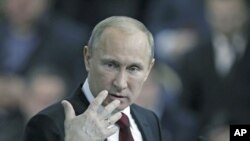
Russians go to the polls Sunday to elect a new president. There's much at stake for the former president, Prime Minister Vladimir Putin.
There are five candidates for the Russian presidency, including Communist Party leader Gennady Zyuganov and billionaire businessman Sergei Prokhorov. But the man who is expected to win the election is Putin.
Last September, he announced he would run for president in the March 4 elections, replacing Dmitri Medvedev, who is expected to become prime minister in a new government.
Protests sparked by fraud charges
The presidential balloting comes several months after Russians went to the polls to elect a new parliament. But there were allegations of widespread fraud during those December elections, sparking huge demonstrations in major Russian cities.
Analysts such as Robert Legvold say the protests have evolved into a direct attack on Putin’s authority.
“It certainly seems to represent many different segments of the population that are simply fed up. The slogan that characterizes everything since the September decision, when Putin simply announced that he was going to be the presidential candidate and almost certainly the elected president, the word, the slogan has been ‘enough’ - ‘We have had enough.’ Or as the Russians would say, ‘We have had it up to our eyeballs,’” said Legvold.
Possibility of second round of voting
Russian electoral law says if no presidential candidate receives more than 50 percent of the votes, a second round is needed.
Sergei Glebov is a Russia expert at Smith College [in Massachusetts].
“There seems to be little doubt right now that Putin will gather more than half of the votes and will win in the first round - although it really will depend on the degree of mobilization of anti-Putin forces. A second round is certainly a distinct possibility,” said Glebov.
Legvold said either outcome will pose problems for Putin.
“If, on the one hand, he wins in the first round, does not have to go to a second round, then among the large segment of the public that already voted in December and have been out in the streets, they are going to see this as a manipulated election and it is going to reinforce the negative impressions that they had in December and acted on," said Glebov. "On the other hand, if it is forced to a second round, he has got a negative vote on his leadership, even if he carries the second round. And he will know that he goes into this next term weakened from anything that he has experienced before.”
Dealing from a weakened position
Glebov agrees.
“What I think is going to be staggeringly different about this election, is that even if Putin wins, he will be a different kind of president. He certainly can no longer claim the same degree of legitimacy, of popular support as he claimed, say, in 2004,” said Glebov.
That year Putin was re-elected in a landslide for a second term as president, receiving 71 percent of the votes cast. His approval rating now is roughly in the mid-40s.
Legvold said if elected president, Putin will have to address the anti-government demonstrations.
He will have to, fairly early on, decide how he will deal with that. Is he going to try to strong-arm it or is he going to begin yielding to it and make some changes that may in fact generate a rejuvenation of broader support for him within the public? That is a question I can not answer. I am not sure he could answer that today, but I certainly can not answer it. I do not know where he will go,” said Glebov.
Many experts say it will be interesting to see in the weeks and months ahead if the anti-Putin protests continue to spread - and if they present a clear challenge to the new Putin presidency.