



News / Europe

Europe Pushes Toward More Bank Funding

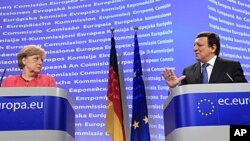
German Chancellor Angela Merkel, left, looks at European Commission President Jose-Manuel Barroso as he speaks during a news conference at the European Commission headquarters in Brussels, Oct. 5, 2011.
TEXT SIZE - +

European officials are moving to add new funding for troubled banks on the continent that are weighed down by the possibility of a Greek default on its debts.

German Chancellor Angela Merkel, leader of the country with Europe's strongest economy, lent her support Wednesday. She said there should be a Europe-wide cash infusion for the banks if  there is a "common view" that the banks need financial help to offset possible losses on government bonds they have bought.

The chief of the International Monetary Fund's European operations, Antonio Borges, said it is "no secret" that the European authorities are working toward adding public money to the coffers of the private banks, much as the U.S. did with its banks in 2008 at the start of the global recession. One international investment bank, Morgan Stanley, said European banks may need $186 billion in new funding.

The bank rescue attempt came as French and Belgian officials worked to keep the cross-border Dexia bank from collapsing. They are planning to put its troubled assets in a separate "bad bank" entity to protect depositors from losing their savings.

In a new report, the IMF said European leaders need to take decisive action to solve the continent's debt crisis, not just solve worries over a possible Greek default. The international funding agency said that Europe needs to use new crisis management provisions it approved in July.

But the IMF said the continent needs to keep money available for economic growth, not just cut government spending.

The agency said the pursuit of deficit targets "should not come at the expense" of risking a widespread recession in 2012, which Borges said "can't be ruled out."

Investors reacted favorably to the new pledges of European action on the debt crisis. Markets in London, Paris and Frankfurt all advanced sharply on Wednesday, after falling significantly earlier in the week.

Some information for this report was provided by AP, AFP and Reuters.

You May Like

India, China Pledge to Overcome Border Tensions

Indian prime minister and Chinese premier attempt to move past tense standoff in the Himalayas during Delhi talks More

Burmese President Opens US Visit with VOA Town Hall Meeting

Ahead of his meeting with President Obama Monday, Thein Sein answered questions on human rights and economic development in his country More

Video Washington Week: Focus on Burma, US Government Scandals

President Thein Sein visits the White House on Monday, Congressional probes of multiple scandals are continuing More

This forum has been closed.
Comments
     
There are no comments in this forum. Be first and add one

Featured Videos

Your JavaScript is turned off or you have an old version of Adobe's Flash Player. Get the latest Flash player.
Video

Video Boston Bomber Spent 6 Months in Russia’s Most Violent Republic

The news of the Boston Marathon bombings circled the globe, and resonated here in Dagestan, a majority Muslim republic in Russia, on the shores of the Caspian Sea. Last year, Tamerlan Tsarnaev, the older of two brothers suspected of the bombings and a long-time Boston resident, returned to Dagestan, where he had lived for a year during his youth. Dagestan was the land of his maternal ancestors. But in the last two years, this republic of 3 million people has gained notoriety as the region with the highest level of political and religious violence in all of Russia. VOA's James Brooke reports from Makhachkala, Russia.