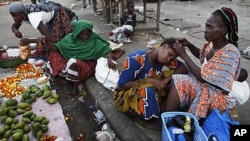
The International Monetary Fund (IMF) says rising food and fuel prices are challenging sub-Saharan Africa's recovery from the global financial crisis.
The IMF says economic growth in sub-Saharan Africa has largely recovered from the global financial crisis, and is forecasting 5.5 percent GDP growth this year and nearly six percent in 2012.
But the region's central banks may be moving too slowly to raise interest rates to keep pace with higher food and fuel prices. IMF deputy director for Africa Saul Lizondo says most sub-Saharan economies are now facing higher import bills, with the price of oil up more than one-third from last year.
"There is some concern about monetary policy, interest rates," said Lizondo. "Real interest rates are much lower than they were before the crisis and now with this increase in oil and fuel prices we are concerned [with] the recovery in growth in these economies; we are concerned that this may have an impact on the inflation since monetary policy work with long lags. It is important to be proactive in this area and not wait for lots of evidence about the impact on prices because then it might be too late."
The IMF's 2011 Regional Economic Outlook for sub-Saharan Africa shows lower-income countries growing the fastest. Ethiopia's economy is forecast to grow more than eight percent this year. Middle-income countries are lagging behind. South Africa's growth is projected to be just 3.5 percent.
Abebe Selasssie is the IMF Africa department's division chief.
"Most of the countries are recovering to pre-financial crisis growth rates, and if you remember this period was the best for the region going back to at least [the] 1970s," said Selasssie. "So the countries have exhibited a lot of resilience. I think an important factor for this resilience has been the fact that these countries have relied on counter-cyclical policies to help cushion the adverse effects of the crisis on output."
Counter-cyclical economic policies seek to maintain stability by going against the current trend - cooling the economy when it is growing, for example, or stimulating growth when it is contracting.
High levels of foreign investment in smaller economies led to big swings in exchange rates when those investors pulled out during the financial crisis. Lizondo says some sub-Saharan economies may now consider limits on outside capital to lower the chance of that happening again.
"The best way to deal with these capital inflows is to strengthen financial systems and regulation supervisions to regulate this flow," added Lizondo. "Second, in terms of macro-economic polices for countries that have no reserves, they can accumulate reserves. The countries in which the exchange rate is undervalued can order for some appreciation, but there may be a situation in which all those measures are not very effective. In which case then, there may be a case for capital controls."
The IMF groups 11 sub-Saharan economies into what it calls "frontier markets" that have natural resources, viable financial markets, and relative political stability. Of those economies, Ghana, Mauritius, and Zambia have best recovered outside investment following the global financial crisis. The IMF says there has been no recovery in Tanzania or Uganda.
IMF: Rising Prices Threaten African Economic Recovery