Special agents with U.S. Immigration and Customs Enforcement's Homeland Security Investigations escort Jorge Sosa, a former Guatemalan army commando, following his extradition, Sept. 22, 2012.
A new report casts immigration enforcement as the U.S. government's top anti-crime priority, marked by a two-decade shift in funding that has put more staff, equipment and screening capabilities to work protecting the country's borders.
The report by the non-partisan Migration Policy Institute, based in Washington, comes amid recent reforms by the White House easing policies for some illegal immigrants and criticism by Republican lawmakers who want a greater focus on enforcement efforts.
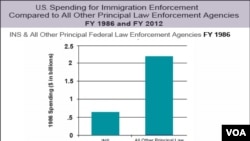
The report notes that funding last year for immigration enforcement agencies totaled close to $18 billion, more than $3 billion higher than the combined budgets of the country's other principal law enforcement agencies. That $18 billion figure includes the budget of the U.S. Customs and Border Protection, which has some functions not related to immigration, such as inspecting cargo at U.S. ports.
Rising Costs of Immigration Enforcement
But in 1986, spending for the other agencies was several times higher than the chief immigration enforcement body. That same year, lawmakers enacted an immigration reform act that included amnesty for about 3 million illegal immigrants.
Since then, the report says, the United States has spent $187 billion on immigration enforcement, creating historic levels of border patrol staffing and infrastructure.
Apprehensions at the nation's borders have dropped dramatically, from more than 1.6 million in 2000 to about 340,000 in 2011. Meanwhile, the number of non-citizens deported from the United States has risen sharply, from 30,000 in 1990 to nearly 392,000 in 2011.
U.S. Immigration Spending
Doris Meissner, the head of MPI's U.S. Immigration Policy program, says that while the government has focused on building enforcement capabilities and improving their performance, enforcement alone is not sufficient to address the challenges that immigration poses to the country's future. Meissner served as commissioner of the U.S. Immigration and Naturalization Service in the 1990s.
The report, released Monday, says fewer than half of those deported from the United States are removed following a hearing, with the Department of Homeland Security using its administrative powers to carry out a majority of the removals.
It also notes the role of economic factors in the shifting pattern of immigration, with a weaker U.S. economy and more opportunities at home slowing the number of people seeking to get into the country.
The Voice of America provides news and information in more than 40 languages to an estimated weekly audience of over 326 million people. Stories with the VOA News byline are the work of multiple VOA journalists and may contain information from wire service reports.