



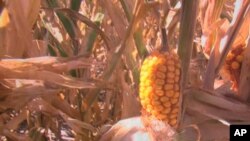
With water scarcity emerging as a major global issue in the 21st century, a drought in the southern U.S. state of Texas highlights the need for farmers to get more out of limited water supplies. Some are using new irrigation methods which give them more crop per drop.
The driest year and the hottest July and August on record have taken a toll on the region's crops, costing the state's farmers and ranchers more than $5 billion so far.
Near the town of Dumas, in the northern Texas High Plains, farmer Harold Grall says it's the worst he's seen in 33 years of farming.
"We need to take away something good from this year, since it's been such a difficult year," he says, "We are learning a lot."
The summer's extreme drought and heat highlight every shortcoming in the way farmers water their crops, says Texas A&M University irrigation expert Nich Kenny.
"You hate to see a person go through that, but if it affects the management regime and the strategies that people use for the better, this year may be a year that changes crop production in the Texas High Plains."
Running out of water
Those changes have to come, says Grall. While this year was extreme, "we know the direction we're heading," says Grall. "It's like, what part of 'We're running out of water' don't you understand?"
Maize is the most profitable crop to grow in this area. But farmers cannot grow maize in this semi-arid landscape without irrigation.
However, every drop of irrigation water comes from an underground reservoir that farmers, cities and industries are draining far faster than the water replenishes.
Some areas have a century or more before the wells run dry. But others have just a decade or two at current rates of use.
When the water dries up, so will the region's economy, says Steve Walthour, head of the North Plains Groundwater Conservation District, the region's water authority.
"Our bread and butter is irrigated agriculture. And we have to look at how do we keep it going for as long as we can."
High-tech maize field
A walk through one of Harold Grall's maize fields provides a look at the latest in maximizing crop per drop.
Grall is trying out a new high-tech system that sends data from underground soil probes to his computer. It tells him when his plants need water, and when he can turn off the taps.
"We have real-time access to what's going on in the soil," he says.
This system is not cheap. Each underground probe costs $2,500. But since this only is his second year with the system, he has a low-tech backup: wires poking out of the soil connect to blocks of gypsum buried underground. Hooking up an electrical meter will give an idea of how dry the soil is.
Rather than tilling the leaves and stalks from last year's crop into the soil, Grall leaves them on the field. The cover helps cool the soil, and it reduces evaporation and runoff.
"That residue is just like a big sponge," he says. "It's just kind-of soaking up all the water," and holding on to it for the plants to use.
New maize varieties
The plants themselves need less water. This year, Grall is trying out new, drought-tolerant maize varieties from two seed companies. In this year's exceptional drought and heat, they clearly out-performed older varieties.
Grall uses low-hanging irrigation hoses that deliver water right to the base of the plant. Compared to the old, wasteful method of flooding the crop rows, it's a big improvement.
The North Plains Groundwater Conservation District helped Grall set up some of the new technologies to demonstrate to the region's farmers that they can produce a profitable maize crop on less water.
They are still sorting through all the data to determine how it all worked and what needs to be improved.
But, Grall says, "We need all the tools available to us at this point so we can help preserve our water," because water is the lifeblood of a region where farming is not just a business but also a way of life.