


The incumbent government of Ivory Coast is rejecting the African Union's endorsement of the United-Nations certified winner of November's presidential election, saying African leaders are making the situation worse and will be held accountable for a possible return to civil war.
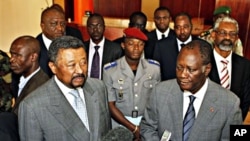
Former Prime Minister Alassane Ouattara says African Union leaders meeting in Ethiopia Thursday endorsed his election and now believe incumbent president Laurent Gbagbo must leave power.
"We had a good meeting with the panel of heads of states and they reconfirmed that I am the president elected by the Ivorian People, and now it's a final decision so there is no way to go back on that. And at the same time they asked me if I could, in a framework of reconciliation, have a government which would take into account other parties and the civil society and try to find an honorable exit to for Laurent Gbabgo,” Ouattara said. “Obviously I accepted that because I want peace for Cote d'Ivoire."
Ouattara says he will now work to form a government for Ivory Coast that includes members of Gbagbo's party.
"It's a government that I will form which will include members of other parties that I will select,” he added. “It is different to say that it is a National Unity Government as if ministers will be opposed to me, that is not the case. So it will be a government where I will take the best people in Cote d'Ivoire to run a disaster situation because the situation is a....the economy is completely down and the social indicators are worse than we have seen since independence. So I want to have a strong team, a team of competent people from all parties and from the civil society but I will select them. Well Gbabgo will have an honorable exit and thereafter when he comes to see me we'll discuss that."
Gbagbo was invited to the talks in Ethiopia but refused to attend. His representative, Pascal N'guessan, says the African Union decision will not help resolve the crisis peacefully.
Nugessan says Africa and the African Union are contributing to the worsening situation in Ivory Coast, and will be accountable for an eventual civil war that could take place.
Gbagbo's government continues to insist that he was re-elected because a council of his allies annulled as fraudulent nearly ten percent of all ballots cast.
Nguessan says Gbagbo is open to all negotiations but will not accept anyone denying his victory without any reason or argument.
On his first trip outside Ivory Coast since November's vote Ouattara worked to solidify near-unanimous international support for his government in meetings with nearly 30 diplomats including representatives of the European Union, the United States, India, and Brazil.
He meets in Nigeria Friday with President Goodluck Jonathan who has led the push for West Africa's regional alliance to use force to drive Gbagbo from power.
Ouattara's return to Abidjan is complicated by the Gbagbo government banning United Nations flights over Ivorian airspace. Ouattara used a U.N. helicopter to leave the Abidjan resort hotel where he is guarded by U.N. peacekeepers.
The Secretary General's special representative for Ivory Coast, Young-jin Choi, says the United Nations does not recognize that flight ban because it does not recognize Gbagbo's government.
"We receive our mandate from the Security Council,” Choi said. “We were told to ensure our freedom of movement on land and in the air. We are going to do it."
Choi says the area of Abidjan controlled by militia loyal to Ouattara is growing. Gbagbo's government says U.N. peacekeepers are helping rebels. Choi says that is propaganda meant to incite further attacks against U.N. troops, which he says constitute war crimes.
Aide Says Gbagbo Rejects AU Endorsement of Ouattara as Ivory Coast Leader