



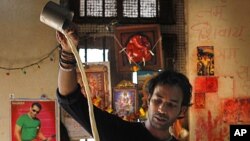
India is traditionally a tea-drinking country. But it is now acquiring a taste for coffee, prompting global coffee chains to eye the huge market. And local entrepreneurs are also hoping to cash in on the country’s tea-drinking habits by opening new outlets to promote the beverage.
It is just 10:30 in the morning, but two cafés located within meters of each other, opposite a college in New Delhi, are doing brisk business. Their main customers - undergraduate students.
In the past decade, India’s huge young population has quickly embraced a coffee culture as cafés become the hip and convenient place to spend time.
The result - coffee chains have expanded fast and furiously, fanning out from big metros like New Delhi and Mumbai to small towns and highways.
Coffee consumption has doubled in the last 10 years.
It is the promise of this market that is luring chains like American-based Starbucks to enter India. It will open its first outlets here, later this year. In addition to domestic chains, Lavazza and Costa Coffee are already present.
The head of India Coffee Trust, Anil Kumar Bhandari, says Starbucks will come to a country where cafés have become central to the lifestyle of young, middle-class Indians as incomes grow and global trends catch on.
“They should have been here before... Almost any café chain which has a reasonable quality with its service, ambiance and food, and coffee first, will succeed in this country. Because look at the young population, [it] is growing and they are all taking to it like ducks to water,” Bhandari said.
But coffee’s growing popularity does not mean that tea, which Indians have consumed for more than 150 years, is moving over.
India is one of the world’s major tea-growing countries and a cup of “chai,” as it is known locally, is hugely popular. Indians consume eight times more tea than coffee.
But outside homes and offices, it is mostly sold by street vendors. And that is what entrepreneurs like Amuleek Singh Bijral hope to change. The 36-year-old Harvard graduate has opened a tea retail chain in the southern information technology hub, Bangalore, called Chai Point. These are not upscale cafes, but offer customers more affordable tea in what Bijral calls a clean and hygienic environment.
Instead of cappuccinos, lattés and espressos, they sell lemon tea, iced green tea or masala chai - tea cooked with spices. It is often served in glasses instead of cups, the way many Indians have it at home.
In less than a year, 14 Chai Points have mushroomed in the city. They are not competing for image with cafés because, as Bijral points out, “chai” is the common man’s beverage.
“You can not [over] price it. You can not give it an elitist twist. We are very clearly not a high-street phenomenon. We are not a mall phenomenon," Bijral noted. "We do not think that is the mass of India, so we very clearly have defined our sweet spot where we say we are going to target the working Indian and serve people who are in the habit of drinking 'chai' three to four times a day.”
Another entrepreneur has launched a similar tea venture in the northern city, Jaipur. Thirty-year-old Manasi Chadha in Bangalore welcomes these outlets.
“Drinking tea is a kind of in-home kind of thing, out-of-home options like this are new. Especially since coffee-drinking has boomed in the last couple of years," Chadha said. "This is a little different.”
And as health becomes high on the agenda of many consumers, the tea restaurants hope to quietly stress the advantage of a beverage that is low on caffeine and high on antioxidants.
Business analysts say it is not a case of coffee or tea. They say that in a country where half the billion-plus population is under 25, both cafés and tea points will find plenty of room to grow.