


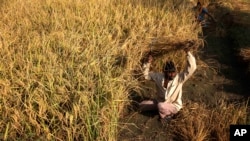
India’s rice exports to Iran have been rising since Tehran agreed to accept payment in India’s local currency for its oil. India wants to use this money to fund its exports to Iran, but efforts to step up trade between the two countries continue to face several hurdles due to Western sanctions on Tehran over its nuclear program.
A delegation from the All India Rice Exporters Association is getting ready to visit Tehran in early April to see how to strengthen business. The visit comes amid a recent surge in exports of rice to Iran. From April to December last year, Iran imported more than $725 million worth of rice - up 20 percent from the previous year.
India has been one of Iran’s biggest rice suppliers for many years. But business grew after New Delhi began to pay Tehran for oil partly in its local currency. These rupee resources, which are piling up in an Indian bank, are being used to fund Indian exports to Tehran.
Rice traders say the arrangement has ended the uncertainty over payments that arose due to Western sanctions on Iran.
"There are some issues still there, but people are aggressive in selling, and you see if the buyer makes money, he is a little more aggressive to sell. The rice prices have gone up in India, and Indian exporters are making good money," said Vijay Setia, who heads the All India Rice Exporters Association.
Rice traders are not the only ones eyeing the Iranian market. Indian pharmaceutical companies are also trying to increase exports to Iran amid a reported shortage of several medicines in that country. Sugar, tea, and iron and steel are some of the other items which India sells to Tehran.
However, India’s exports are worth far less than its oil imports from Iran, which amount to about $1 billion a month. New Delhi wants to increase trade with Iran - partly so that the rupees which are accumulating in India for oil payments can be used to finance exports.
But a refusal by many insurers to give coverage to shipments to Tehran is posing fresh hurdles.
Rafique Ahmed, president of the Federation of Indian Export Organization, which has been urging Indian companies to step up exports to Iran, says trade with Iran increased by 11 percent last year, but is not growing as much as expected.
"Definitely the sanctions are creating a problem because not everybody wants to take a risk of not having insurance and everything. So it is not increasing as much as we wanted it to increase," he said.
There are also fears that India’s oil imports from Iran could face further problems because domestic insurance companies have expressed concerns about giving coverage to refineries which process the oil.
New Delhi, which has friendly relations with Iran, is its second biggest customer for oil, although oil imports have dropped by about 20 percent in response to pressure from the United States.
A delegation from the All India Rice Exporters Association is getting ready to visit Tehran in early April to see how to strengthen business. The visit comes amid a recent surge in exports of rice to Iran. From April to December last year, Iran imported more than $725 million worth of rice - up 20 percent from the previous year.
India has been one of Iran’s biggest rice suppliers for many years. But business grew after New Delhi began to pay Tehran for oil partly in its local currency. These rupee resources, which are piling up in an Indian bank, are being used to fund Indian exports to Tehran.
Rice traders say the arrangement has ended the uncertainty over payments that arose due to Western sanctions on Iran.
"There are some issues still there, but people are aggressive in selling, and you see if the buyer makes money, he is a little more aggressive to sell. The rice prices have gone up in India, and Indian exporters are making good money," said Vijay Setia, who heads the All India Rice Exporters Association.
Rice traders are not the only ones eyeing the Iranian market. Indian pharmaceutical companies are also trying to increase exports to Iran amid a reported shortage of several medicines in that country. Sugar, tea, and iron and steel are some of the other items which India sells to Tehran.
However, India’s exports are worth far less than its oil imports from Iran, which amount to about $1 billion a month. New Delhi wants to increase trade with Iran - partly so that the rupees which are accumulating in India for oil payments can be used to finance exports.
But a refusal by many insurers to give coverage to shipments to Tehran is posing fresh hurdles.
Rafique Ahmed, president of the Federation of Indian Export Organization, which has been urging Indian companies to step up exports to Iran, says trade with Iran increased by 11 percent last year, but is not growing as much as expected.
"Definitely the sanctions are creating a problem because not everybody wants to take a risk of not having insurance and everything. So it is not increasing as much as we wanted it to increase," he said.
There are also fears that India’s oil imports from Iran could face further problems because domestic insurance companies have expressed concerns about giving coverage to refineries which process the oil.
New Delhi, which has friendly relations with Iran, is its second biggest customer for oil, although oil imports have dropped by about 20 percent in response to pressure from the United States.