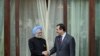



In yet another sign of improving ties between India and Pakistan, the foreign ministers of the South Asian rivals have announced plans to hold talks in mid July.
The announcement that India's foreign minister S.M. Krishna will head to Islamabad on July 15 for a dialogue with his Pakistani counterpart was made following a telephone conversation between the two ministers.
Krishna said he has accepted an invitation from the Pakistani foreign minister and is looking forward to the talks.
"Let us hope these talks will be helpful in bringing our two countries closer together, bringing our two countries the cordiality that all of us desire, and let us hope that our effort will be fruitful," Krishna said.
The decision to hold the dialogue is a signal that New Delhi is ready to normalize ties with Pakistan in the wake of the 2008 terror attacks in Mumbai which prompted India to put on hold a peace process. Contacts between the two countries have since been limited.
The July 15 meeting is expected to focus on how to reopen the stalled peace dialogue.
Pakistani foreign minister Shah Mehmood Qureshi says both ministers had a good phone conversation. He said they felt that it is important to bridge the trust deficit between the two countries, and create an "enabling environment" for a dialogue.
"We will build it from here, recognizing the challenges, recognizing the fact that it is not going to be easy, recognizing the fact that is not going to be easy, recognizing the fact that there are no quick fixes, but sincerity is there," says Qureshi.
Qureshi says he will travel to New Delhi for a further round of talks after the July 15 meeting.
Another high-level interaction between the two countries will take place next month when the Indian Home Minister P. Chidambaram will hold bilateral talks when he visits Islamabad on June 26 for a regional meeting.
India had earlier said that it could only normalize ties if Islamabad acts against the planners of the Mumbai attacks, which it blames on Pakistan-based militants.
But the thaw in their ties was evident when the prime ministers of the two countries agreed to draw up a road map for future talks when they met on the sidelines of a regional summit.
The Indian Prime Minister is said to be in favor of trying to build bridges with Pakistan. The United States has also been urging both countries to return to the negotiating table.
The relations between the neighbors are troubled by their dispute over Kashmir and Indian accusations that Pakistan does not do enough to stop Pakistan-based Islamic militants from mounting terror attacks in India.