



News / Asia

India, Pakistan Agree to Resume Comprehensive Dialogue

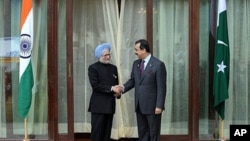
Indian Prime Minister Manmohan Singh (L) and his Pakistani counterpart Yousuf Raza Gilani  shake hands prior to bilateral talks on the sidelines of the eight-nation South Asian Association for Regional Co-operation (SAARC) summit in Thimphu, Bhutan, 29 Ap
Indian Prime Minister Manmohan Singh (L) and his Pakistani counterpart Yousuf Raza Gilani shake hands prior to bilateral talks on the sidelines of the eight-nation South Asian Association for Regional Co-operation (SAARC) summit in Thimphu, Bhutan, 29 Ap
TEXT SIZE - +

India and Pakistan say they have agreed to resume stalled talks to normalize relations. The prime ministers of the neighboring rival countries met on the sidelines of a regional leaders' conference in the Himalayan kingdom of Bhutan.

Diplomats from both countries say India's Prime Minister, Manmohan Singh, and his Pakistani counterpart, Yousuf Raza Gilani, talked for about an hour - their first meeting in more than nine months. And their discussion was followed by further talks among their top diplomats.

Pakistan's Foreign Minister, Shah Mehmood Qureshi, told reporters the discussions were "warm, cordial and engaging" leading to a change of climate, which he partly credits to the setting and ambience of Bhutan.  
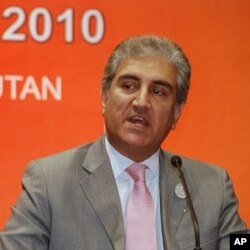
Pakistani Foreign Minister Shah Mehmood Qureshi at news conference in Thimphu, Bhutan, 29 April 2010

"We have decided to move forward. We have overcome the suspension of our [negotiating] process. And that's good news for India, that's good news Pakistan, that is good news for the region," Qureshi saod.

Qureshi says, at subsequent talks among their foreign ministers and foreign secretaries, the dialogue will be "all encompassing" with every issue on the table.

Indian Foreign Secretary Nirupama Rao terms the Thimphu talks "very good" and says the two leaders agreed to have their top diplomats resume dialogue and assess why there is a lack of mutual trust between the two nuclear-armed neighbors.

The peace process has been suspended since the November 2008 terror attack on Mumbai which India blamed on Pakistani-based terrorists.

The neighbors have numerous unresolved issues, including a particularly contentious territorial dispute over Kashmir and how to share river water.

India and Pakistan have been under international pressure to resume negotiations. New Delhi has resisted, insisting it wanted to see more determination by Pakistan to take action against extremists.

This fresh diplomatic breakthrough came as leaders of eight countries concluded their annual summit of the South Asian Association of Regional Cooperation.

You May Like

India, China Pledge to Overcome Border Tensions

Indian prime minister and Chinese premier attempt to move past tense standoff in the Himalayas during Delhi talks More

Burmese President Opens US Visit with VOA Town Hall Meeting

Ahead of his meeting with President Obama Monday, Thein Sein answered questions on human rights and economic development in his country More

Video Washington Week: Focus on Burma, US Government Scandals

President Thein Sein visits the White House on Monday, Congressional probes of multiple scandals are continuing More

This forum has been closed.
Comments
     
There are no comments in this forum. Be first and add one

Featured Videos

Your JavaScript is turned off or you have an old version of Adobe's Flash Player. Get the latest Flash player.
Video

Video Boston Bomber Spent 6 Months in Russia’s Most Violent Republic

The news of the Boston Marathon bombings circled the globe, and resonated here in Dagestan, a majority Muslim republic in Russia, on the shores of the Caspian Sea. Last year, Tamerlan Tsarnaev, the older of two brothers suspected of the bombings and a long-time Boston resident, returned to Dagestan, where he had lived for a year during his youth. Dagestan was the land of his maternal ancestors. But in the last two years, this republic of 3 million people has gained notoriety as the region with the highest level of political and religious violence in all of Russia. VOA's James Brooke reports from Makhachkala, Russia.