



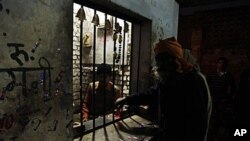
Police in India's West Bengal state say they have arrested a key figure responsible for distributing poisonous homemade alcohol that killed scores of people last year.
Illegal alcohol is a widespread problem in India, where it offers short-term relief from life's hardships, but takes a heavy toll on health.
Habibul Gazi, for example, will never be able to see again. Doctors say his optic nerves have been irrevocably damaged by consuming illegally produced toxic alcohol.
"I asked him to stop drinking, but he never listened," says his distraught wife via translator, explaining that he beat her during arguments about drinking. Now, she says, her family is ruined.
Class and caste
The notion of moderate social drinking has taken root primarily among India's elite and emerging wealthy classes. But in areas where life is much harder, so is the drinking.
The government taxes alcohol heavily, in part to discourage binge consumption. But former tax official Bijay Chakrabarty says the high taxes only drive many people to consume the so-called "hooch."
"Now a poor man cannot afford licit liquor when hooch is available at such a cheap price," he says. "Moreover, licit liquor is available only at fixed places licensed by government, whereas hooch liquor [has] no fixed place. At every nook and corner of a village or a town you can have it."
Small illegal hooch-producing operations are numerous and often spring up just as quickly as they are swept away.
Makers of hooch, also called "country liquor," use a very crude distillation process that can leave a lot of impurities in the final product. They sometimes add chemical extenders, even fuel products, that can produce deadly consequences.
In December, headlines abounded with reports of at least 150 people dying in West Bengal after consuming illegal liquor laced with methanol.
Many ordinary Bengalis, like school teacher Hasanuzzaman Mollah, are skeptical of government promises to crack down on the country liquor industry.
"Many hooch joints are running in front of police stations, right in front of police," he says via translator. "They even get support from police in their illegal dealings."
Indian officials hope to convince more of its poorer citizens that the attraction of alcohol that costs only pennies can carry a very high human cost.
But for Saharun Bibi, whose husband earned a modest income as a tailor before he was killed by homemade liquor, government efforts are too little and too late.
"My husband left nothing to help raise our eight children," she says via translator, adding that she is clueless about how to marry off her daughters and feed the family.