



News / Africa

Initial Results Show Approval of Niger's New Constitution
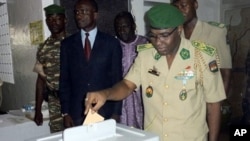
The head of the military junta, General Salou Djibo, casts his ballot in Niamey as Niger voted today in a constitutional referendum, 31 Oct 2010
TEXT SIZE - +

Partial results from Sunday's referendum in Niger show overwhelming support for constitutional changes that would lessen the president's power.  

With nearly a quarter of the ballots counted, it appears at least 80 percent of Niger's voters voted "yes" on a referendum to change the West African country's constitution.

During Sunday's vote, military leader General Salou Djibo called for Nigeriens to vote for the change in order to usher in a new democratic system.

He said the referendum would lead to a democratic system of political stability.  Djibo has served as head of the interim government in Niger since a February coup displaced then-president Mamadou Tandja.

In August of 2009, Tandja pushed through a new constitution for Niger that abolished term limits and increased the president's power.  When Niger's parliament and constitutional court said the vote was illegal, he dissolved both bodies and ruled by decree.

The president's refusal to give up power at the end of his second five-year term sparked widespread protests, and after military leaders toppled him, they named a consultative counsel to draft a new constitution . The counsel settled on what is known as a semi-presidential system where the chief executive's powers are limited.

But voter turnout to approve or disapprove this new constitution was low, said one election official, Salif Boubacar.

He says he does not know what the people think or if the referendum was important for them.  He says there were a lot of people who came to get their voting cards, but did not vote.

The alliance of political parties that supported former president Tandja says the new constitution's weakening of executive powers is a mistake because Niger needs a strong central authority to manage such a vast, underdeveloped country with huge population growth.

Presidential and legislative elections in Niger are scheduled for January 31.

You May Like

Experts Weigh In on Challenges of Closing Guantanamo Prison

Former chief military prosecutor at Guantanamo delivers petition to White House with more than 370,000 signatures, demanding facility be closed down immediately More

Karzai to Discuss Enhancing Defense Ties with India

Afghanistan looking for more military aid as it prepares for withdrawal of NATO forces by next year More

India, China Pledge to Overcome Border Tensions

Indian prime minister and Chinese premier attempt to move past tense standoff in the Himalayas during Delhi talks More

Burmese President Opens US Visit with VOA Town Hall Meeting

Ahead of his meeting with President Obama Monday, Thein Sein answered questions on human rights and economic development in his country More

This forum has been closed.
Comments
     
There are no comments in this forum. Be first and add one

Featured Videos

Your JavaScript is turned off or you have an old version of Adobe's Flash Player. Get the latest Flash player.
Video

Video US Oil Surge Could Impact Mideast Geopolitics

The United States will account for a third of new oil supplies over the next five years, and will become energy self-sufficient in 20 years, according to a new report by the Paris-based International Energy Agency (IEA). Although U.S. oil imports from Arab Gulf countries increased last year, analysts predict the U.S. will lose its dependence on Middle East imports, which is expected to have a huge impact on international relations and the balance of power. VOA's Henry Ridgewell reports.