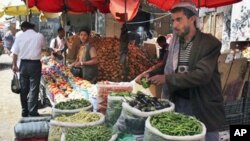
Lingering instability in North Africa and the Middle East is pushing food prices close to record highs.
The World Bank said Thursday food prices have increased 36 percent since this time last year, helping push about 44 million people into poverty.
It also warned that another 10 percent increase in food prices would drive another 10 million people into extreme poverty, subsisting on less than $1.25 a day.
World Bank President Robert Zoellick told reporters in Washington ahead of the World Bank and International Monetary Fund Spring Meetings that the world was in what he called a "danger zone." He said there is a risk food prices will see new spikes over the next two years.
The latest data from the World Bank show food prices remain close to their 2008 peak, with the price of key commodities like maize and wheat jumping about 70 percent over the past year. The cost of soybeans (up 36 percent) and sugar (up 21 percent) has also seen significant increases.
Zoellick said instability in North Africa and the Middle East, which has already been fueling a jump in oil prices, is a key reason food prices are soaring. Severe weather is some grain exporting countries has also contributed to the increase.
Meanwhile, the International Monetary Fund is warning the global economic recovery is getting stronger but that the world remains in crisis.
Speaking at a news conference ahead of the Spring Meetings, IMF Managing Director Dominique Strauss-Kahn warned "it is not the recovery we want" and that global financial leaders cannot be lulled into complacency.
Strauss-Kahn said despite signs that key economies are expanding; they are not producing enough jobs. He said without those jobs, the benefits of a recovery will not be passed along to the general population.
Strauss-Kahn said Tunisia and Egypt were good examples of countries where key economic indicators pointed to growth but where the impact failed to reach the average person.
In both countries, popular revolts led to the overthrow of the government.
The IMF managing director also said the economies of many developing countries are in danger of overheating, while the global economy as a whole remains unbalanced.
Mideast, N. Africa Instability Driving Food Costs to Near All-Time High