


WASHINGTON —
As U.S. officials raise the alarm about perceived Syrian government preparations to use chemical weapons in the country’s civil war, some analysts see those weapons playing other roles in the conflict.
They say the United States and its allies also are weighing several options and risks in planning their response to the threat of chemical warfare in Syria.
The threat appeared to grow Monday as U.S. officials said intelligence sources detected moves by Syrian authorities to combine the components of the nerve agent sarin.
They said it was not clear if Syrian President Bashar al-Assad has decided to deploy deadly sarin gas against rebels trying to end his 12-year rule. But U.S. President Barack Obama warned that Assad would be held accountable if he takes such a step, without saying how Washington would respond.
Suspected stockpiles
Sarin
VX
Mustard Gas
Source: CDC
Western security analysts believe Syria also has stockpiles of VX gas, a deadlier nerve agent, and mustard gas, a blistering agent that usually is not lethal.
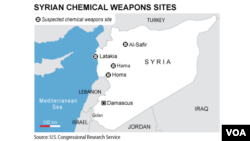
They say Syria’s arsenal is tightly guarded by Assad loyalists at several sites around the country, including the capital, Damascus, and the cities of Hama, Homs, Latakia and al-Safir.
Syria has not denied possessing chemical weapons and has not signed an international convention banning their use. But, Damascus has said it would never deploy such munitions against its own people.
Assad’s pledge
Dave Hartwell, a Middle East researcher at IHS Jane’s in London, said he doubts the Syrian president would violate that pledge.
"Mr. Assad is not Saddam Hussein," noted Hartwell. "He is a very different type of ruler, not as dictatorial in the cruel sense."
The deposed Iraqi leader’s forces killed thousands of minority Iraqi Kurds in a 1988 chemical attack on the northeastern city of Halabja.
Negotiating tactic?
Hartwell said Assad appears to be keeping Syria’s chemical weapons in reserve as a bargaining chip with Western and Arab powers who want him ousted.
"Perhaps [he wants] to negotiate some form of surrender or some form of handover [of the weapons] to international authorities in exchange for immunity from prosecution in the future," he said.
Al-Qaida’s role
Hartwell said the West is more concerned about the risk of Syria’s chemical weapons falling into the hands of al-Qaida-linked Islamist militants who have joined the fight against Assad.
Dany Shoham, a researcher at Israel’s Begin-Sadat Center for Strategic Studies, said he believes Assad would act to prevent al-Qaida from capturing and using the chemical agents.
"If his regime is about to fall, most probably he would prefer to ‘rescue’ those weapons and let [his] Iranian [allies] have them," said Shoham.
He said another possibility is that Assad would transfer chemical munitions to his Lebanese ally Hezbollah, a militant group that dominates Lebanon’s government.
US options
Hartwell said any attempt by the United States and its allies to secure Syria’s chemical weapons and prevent their use or transfer would require sending in ground troops to guard the stockpiles.
He said one option would be for the U.S. military to enter Syria, perhaps with special operations forces such as those sent to neighboring Jordan earlier this year to train Jordanian troops.
The Obama administration previously has expressed a reluctance to intervene in such a way, fearing that could exacerbate Syria’s fighting and plunge the United States into another costly Iraq-style war.
"[Washington] also could provide logistical back-up or transport for troops from other countries to go in, perhaps from Jordan or Turkey," said Hartwell.
Intervention risks
But Western military planners also face two major hazards in Syria.
Israeli researcher Shoham said one possibility is that Assad would be provoked into using his remaining chemical arsenal against the invading forces.
"Another risk is that there would be a massive environmental contamination from attacking those weapons and trying to destroy them," he said.
They say the United States and its allies also are weighing several options and risks in planning their response to the threat of chemical warfare in Syria.
The threat appeared to grow Monday as U.S. officials said intelligence sources detected moves by Syrian authorities to combine the components of the nerve agent sarin.
They said it was not clear if Syrian President Bashar al-Assad has decided to deploy deadly sarin gas against rebels trying to end his 12-year rule. But U.S. President Barack Obama warned that Assad would be held accountable if he takes such a step, without saying how Washington would respond.
Suspected stockpiles
Suspected Syrian Chemical Weapons
Suspected Syrian Chemical WeaponsSarin
- Man-made highly toxic odorless, tasteless, colorless nerve agent
- Possibly used during Iraq-Iran war
- Exposure can be by inhalation, ingestion and skin absorption; people can recover with treatment form mild or moderate exposure
VX
- Odorless, tasteless man-made nerve agent; most potent of all nerve agents
- Slow to evaporate, can last for days on objects
- Exposure can be through skin contact or inhalation; people can recover with treatment for mild or moderate exposure
Mustard Gas
- Chemical warfare agent that causes skin blisters and mucous membranes
- Sometimes odorless, sometimes smells like garlic, onions or mustard
- Exposure can be by inhalation, ingestion or skin contact
- Vapor released in the air can be carried long distances; exposure not usually fatal
Source: CDC
They say Syria’s arsenal is tightly guarded by Assad loyalists at several sites around the country, including the capital, Damascus, and the cities of Hama, Homs, Latakia and al-Safir.
Syria has not denied possessing chemical weapons and has not signed an international convention banning their use. But, Damascus has said it would never deploy such munitions against its own people.
Assad’s pledge
Dave Hartwell, a Middle East researcher at IHS Jane’s in London, said he doubts the Syrian president would violate that pledge.
"Mr. Assad is not Saddam Hussein," noted Hartwell. "He is a very different type of ruler, not as dictatorial in the cruel sense."
The deposed Iraqi leader’s forces killed thousands of minority Iraqi Kurds in a 1988 chemical attack on the northeastern city of Halabja.
Negotiating tactic?
Hartwell said Assad appears to be keeping Syria’s chemical weapons in reserve as a bargaining chip with Western and Arab powers who want him ousted.
"Perhaps [he wants] to negotiate some form of surrender or some form of handover [of the weapons] to international authorities in exchange for immunity from prosecution in the future," he said.
Al-Qaida’s role
Hartwell said the West is more concerned about the risk of Syria’s chemical weapons falling into the hands of al-Qaida-linked Islamist militants who have joined the fight against Assad.
Dany Shoham, a researcher at Israel’s Begin-Sadat Center for Strategic Studies, said he believes Assad would act to prevent al-Qaida from capturing and using the chemical agents.
"If his regime is about to fall, most probably he would prefer to ‘rescue’ those weapons and let [his] Iranian [allies] have them," said Shoham.
He said another possibility is that Assad would transfer chemical munitions to his Lebanese ally Hezbollah, a militant group that dominates Lebanon’s government.
US options
Hartwell said any attempt by the United States and its allies to secure Syria’s chemical weapons and prevent their use or transfer would require sending in ground troops to guard the stockpiles.
He said one option would be for the U.S. military to enter Syria, perhaps with special operations forces such as those sent to neighboring Jordan earlier this year to train Jordanian troops.
The Obama administration previously has expressed a reluctance to intervene in such a way, fearing that could exacerbate Syria’s fighting and plunge the United States into another costly Iraq-style war.
"[Washington] also could provide logistical back-up or transport for troops from other countries to go in, perhaps from Jordan or Turkey," said Hartwell.
Intervention risks
But Western military planners also face two major hazards in Syria.
Israeli researcher Shoham said one possibility is that Assad would be provoked into using his remaining chemical arsenal against the invading forces.
"Another risk is that there would be a massive environmental contamination from attacking those weapons and trying to destroy them," he said.