News / Middle East

Iran: Agreement Reached with Atomic Inspectors on 'Some Points'

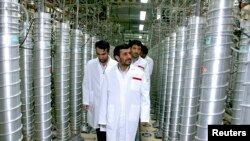
Iranian President Mahmoud Ahmadinejad visits the Natanz nuclear enrichment facility, 350 km south of Tehran, April 8, 2008.
TEXT SIZE - +
VOA News
Iran says it has agreed with United Nations inspectors on "some points" on its nuclear program.

Iran's state-run news agency said Wednesday that some differences were resolved and new proposals made that would be brought up in the next meeting.

It gave no details and the International Atomic Energy Agency had no immediate comment.

The IAEA team is in Tehran for a new round of talks aimed at letting inspectors visit Iranian nuclear sites. Talks last month failed to produce any agreement.  But Tehran has hinted that it may let inspectors visit the Parchin military site, which Western nations suspect is being used to build a nuclear weapon.  Iran says it is a conventional military site and insists its nuclear program is strictly for peaceful purposes.

Map of Iran's nuclear sites

Also Wednesday, Iran said it is upgrading some key equipment at its main uranium enrichment facility.

Developments in Iran Nuclear Standoff:

2013
January:  Iran says it will speed up nuclear fuel work.
February: Iran's supreme leader Ayatollah Ali Khamenei rejects direct nuclear talks with the US.

2012
January:  IAEA confirms Iran is refining uranium to 20% fissile purity.
February:  UN inspectors end talks in Tehran without inspecting disputed military site at Parchin.
April:  Iranian President Mahmoud Ahmadinejad vows Iran will not surrender its nuclear rights.
May:  UN inspectors report they found find traces significantly upgraded uranium at an Iranian site.
July:  EU begins total ban on Iranian oil imports, US expands sanctions.
September:  IAEA demands access to Parchin, Iran calls EU sanctions "irresponsible."
December:  IAEA says it makes progress in talks with Iran.  US imposes more sanctions.
The head of Iran's nuclear energy organization, Fereydoon Abbasi-Davani, told state-run media workers have begun installing a new generation of centrifuges at its Natanz facility.

The upgraded centrifuges are capable of producing highly-enriched uranium needed for nuclear weapons.  

European Union foreign policy chief Catherine Ashton told the U.N. Security Council Wednesday she is hopeful some progress can be made in talks planned for later this month with Iran.

"There is no doubt that the pressure of sanctions has been instrumental in bringing Iran back to the negotiating table. But sanctions cannot be an end in themselves," Ashton said. "The key is for Iran to comply fully with its international obligations."

Ashton has been coordinating talks between world powers and Iran.  The next round of talks involving the United States, Britain, China, France, Russia, Germany and Iran is scheduled for February 26 in Kazakhstan.

You May Like

India, China Pledge to Overcome Border Tensions

Indian prime minister and Chinese premier attempt to move past tense standoff in the Himalayas during Delhi talks More

Burmese President Opens US Visit with VOA Town Hall Meeting

Ahead of his meeting with President Obama Monday, Thein Sein answered questions on human rights and economic development in his country More

Video Washington Week: Focus on Burma, US Government Scandals

President Thein Sein visits the White House on Monday, Congressional probes of multiple scandals are continuing More

This forum has been closed.
Comment Sorting
Comments
     
by: emenot from: Hong Kong
February 13, 2013 5:23 PM
If NK did it with Irans help, why would Iran fore go their nuclear program? It just don't make any sense to believe otherwise!


by: Jay Reams
February 13, 2013 2:12 PM
Article reads: "Iran says it is upgrading some key equipment at its main uranium enrichment facility, a move that could cause further alarm as the international community tries to put the brakes on Iran's nuclear activities."

OK, How much "further alarmed" can you get?????? See the huge elephant in the room?? They along with North Korea have long spoken their intentions. What else does the international community need to hear???? To have them both sit you down and say very slowly like to a child,"Yes we are going to wipe you out as soon as we have the ability". Or that STILL wouldn't be enough of a clue. Talk about dense/ not getting it.

In Response

by: Snow from: United States
February 13, 2013 10:49 PM
You're putting your perception above reality. If you have short-term memory let me remind you that we went to war with Iraq over the lie of possession of WMD's. 130,000 killed, $1 trillion flushed down the toilet, and a wrecked economy to go with it. Making decisions based solely on perception in lunacy.

Iran has not attacked another nation in over 200 years unless attacked first. The Iranian President never threatened to wipe Israel off the map. He was misquoted saying, "The Imam said, this regime occupying Jerusalem must vanish from the page of time." He was calling for a Israeli regime change because of their treatment of Palestinians. Furthermore, both Israeli and American military officials have called the Iranian government a rational government.

In the end facts will always trump beliefs.

Featured Videos

Your JavaScript is turned off or you have an old version of Adobe's Flash Player. Get the latest Flash player.
Video

Video Boston Bomber Spent 6 Months in Russia’s Most Violent Republic

The news of the Boston Marathon bombings circled the globe, and resonated here in Dagestan, a majority Muslim republic in Russia, on the shores of the Caspian Sea. Last year, Tamerlan Tsarnaev, the older of two brothers suspected of the bombings and a long-time Boston resident, returned to Dagestan, where he had lived for a year during his youth. Dagestan was the land of his maternal ancestors. But in the last two years, this republic of 3 million people has gained notoriety as the region with the highest level of political and religious violence in all of Russia. VOA's James Brooke reports from Makhachkala, Russia.