



Years of diplomatic pressure and sanctions from the United Nations and Western powers have so far failed to persuade Iran to give up its nuclear program. This week Iran published figures claiming that trade with China has soared in the past year. The U.S. is pressuring China to adhere to the sanctions - but there are growing calls for a change of approach in the West’s dealings with Tehran.
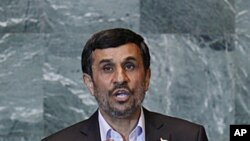
Iran’s President Mahmoud Ahmadinejad used his moment in the global spotlight at the United Nations General Assembly earlier this month to defend his nuclear program. He once more insisted that it is for civilian purposes and renewed his offer to halt the fuel enrichment program that the West fears is aimed at making nuclear bombs.
“At any time that 20 percent enriched fuel, can be made available to us we will immediately cease domestic production of said fuel. We want no guarantees other than the fuel itself - the actual delivery of the fuel,” Ahmadinejad said.
Tehran's refusal to stop has provoked four rounds of U.N. sanctions and tighter U.S. and European Union restrictions.
Jon Davies of the British Foreign Office says the sanctions haven’t worked.
“As, being frank, that has not achieved the effects we wanted," he noted. "Inevitably, that sanctions pressure has broadened and more elements of it now are designed to change behavior of the leadership of Iran, as opposed to specifically and directly targeting the [nuclear] program itself.”
Peter Jenkins, former British ambassador to the U.N.’s nuclear watchdog, the IAEA, says it’s time for a new approach - engaging and trading with Iran to build trust. “The West actually needs more Iranian oil, not less," he said. "The policy is also costing Western exporters orders which have gone to Asian competitors.”
China is one Asian competitor that isn’t letting politics interfere with trade. Iran claims trade with the Chinese will hit $45 billion this year, up 50 percent on last year. In May Iran invited China to tour its nuclear facilities - an effort, say analysts, to create a divide in the U.N. Security Council.
Athar Hussain of the London School of Economics, says Asian powers are willing to help Iran bypass Western sanctions.
“Sanctions are always blurred at the edges. Whoever imposes the sanctions, it depends how they interpret the situation," Hussain stated. "China was never an active supporter of the sanctions against Iran. So obviously some things which Western countries would not do with Iran, China might say, ‘Well there’s nothing in it, and we are perfectly free to trade.”
Hussain says American pressure on China to enforce more compliance with the Iranian sanctions will likely be rebuffed. Nevertheless, Britain and other Western powers insist they will continue to tighten economic and diplomatic pressure on Iran until it halts the nuclear program.